Locations:





Cleveland Clinic News Service | 216.444.0141
We’re available to shoot custom interviews & b-roll for media outlets upon request.
CCNS health and medical content is consumer-friendly, professional broadcast quality (available in HD), and available to media outlets each day.
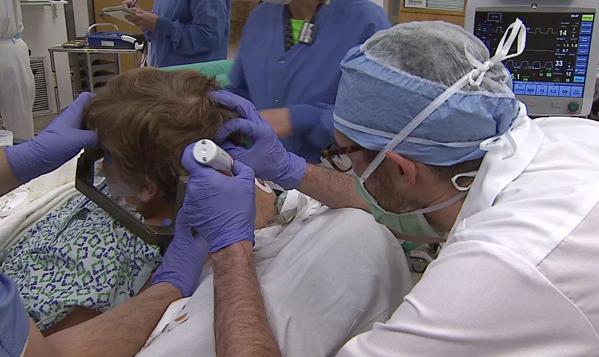
Video content: This video is available to watch online.
View video online (https://www.youtube.com/embed/5sI-mse1h2s)
CLEVELAND – Stroke is the leading cause of disability in the United States.
Significant strides have been made in treating strokes shortly after they happen, but there has not been much, other than physical therapy, that could help people recover from a stroke’s lasting, devastating physical disability – until now.
Cleveland Clinic has enrolled 12 participants in a study to look at whether deep brain stimulation may help people recover from the physical disability often caused by a stroke.
Judy Slater, 59, of Pulaski, Pennsylvania, is the first to undergo the procedure.
Two years ago, Slater suffered a stroke and lost the use of her left arm and hand – as well as her independence.
“I couldn’t do anything,” said Slater. “I had to count on everybody to help me get dressed, get showered; just getting to the bathroom and just even to get outside they had to help me.”
Slater’s deep brain stimulation device was surgically implanted in late 2016.
“Deep brain stimulation is like a brain pacemaker,” said Andre Machado, M.D., PhD, of Cleveland Clinic. “There is an electrode, a wire, that’s implanted into a specific area of the brain that’s expected to produce a specific effect.”
A few weeks after the surgery, the device was programmed and turned on. It didn’t take long for researchers to see that Slater was making progress.
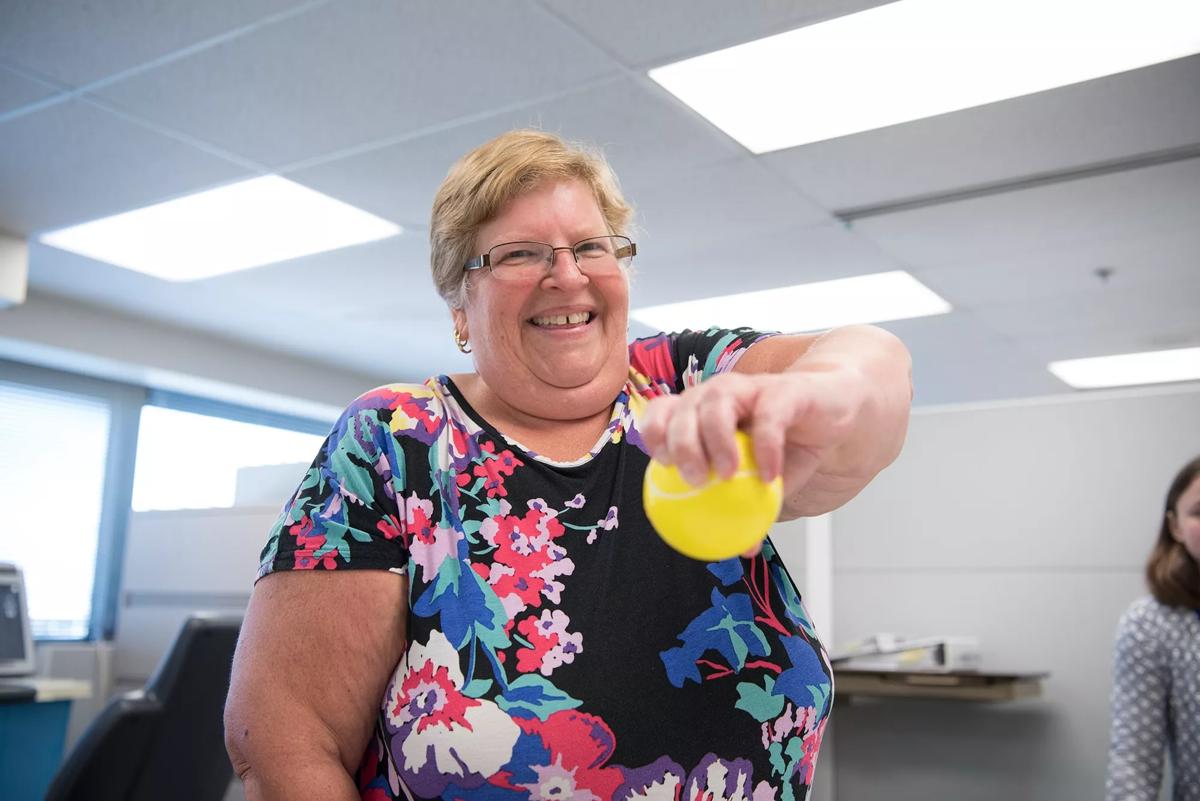
Image content: This image is available to view online.
View image online (https://assets.clevelandclinic.org/transform/6b134115-fd0e-4edc-a371-24dec3d7d4bc/JUDYDBSJPEG_jpg)
Judy Slater shows progress during a physical therapy session
“She could move her arm within a few weeks in a way she had not been able to move since the stroke,” said Dr. Machado. “Judy has made steady progress after the surgery, week after week, month after month, her function continues to improve.”
Before surgery, Slater’s hand was essentially frozen, but after the procedure, and a few months of physical therapy, she can now open her hand and is doing things she couldn’t just weeks earlier.
“I can wash my own hair now and dry it and comb it,” said Slater.
Slater will continue physical therapy as long as she continues to make progress and said her goal is to be able to function as she did before the stroke.
Dr. Machado said the next step in the research is to see if Slater’s results can be reproduced in the other 11 people enrolled in the study.
Watch how brain stimulation may provide hope for stroke patients
Grandmother who suffered stroke regains use of her hand after innovative deep brain stimulation technique. https://t.co/v4jU4tVj35 pic.twitter.com/uzwlHLKxRh
— Cleveland Clinic (@ClevelandClinic) August 10, 2017
Deep brain stimulation shows early promise for restoring movement to patient paralyzed by stroke. https://t.co/v4jU4tVj35 pic.twitter.com/2aFq8ZY9Ud
— Cleveland Clinic (@ClevelandClinic) August 10, 2017
Cleveland Clinic is a nonprofit multispecialty academic medical center that integrates clinical and hospital care with research and education. Founded in 1921 by four renowned physicians with a vision of providing outstanding patient care based upon the principles of cooperation, compassion and innovation, Cleveland Clinic has pioneered many medical breakthroughs, including coronary artery bypass surgery and the first face transplant in the United States. Cleveland Clinic is consistently recognized in the U.S. and throughout the world for its expertise and care. Among Cleveland Clinic’s 83,000 employees worldwide are more than 6,600 salaried physicians and researchers, and 21,900 registered nurses and advanced practice providers, representing 140 medical specialties and subspecialties. Cleveland Clinic is a 6,725-bed health system that includes a 173-acre main campus near downtown Cleveland, 23 hospitals, 300 outpatient facilities, including locations in northeast Ohio; Florida; Las Vegas, Nevada; Toronto, Canada; Abu Dhabi, UAE; and London, England. In 2025, there were 15.9 million outpatient encounters, 343,000 hospital admissions and observations, and 336,000 surgeries and procedures throughout Cleveland Clinic’s health system. Visit us at clevelandclinic.org. Follow us at x.com/CleClinicNews. News and resources are available at newsroom.clevelandclinic.org.
Editor’s Note: Cleveland Clinic News Service is available to provide broadcast-quality interviews and B-roll upon request.
 Search