Locations:




 Search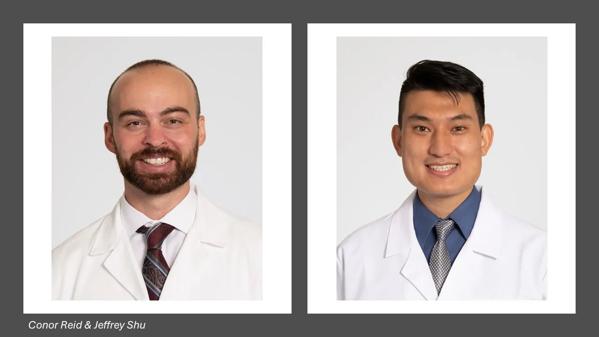
Conor Reid and Jeffrey Shu
The Cleveland Clinic Lerner of College of Medicine of Case Western Reserve University (CCLCM) is a five-year program dedicated to developing the next generation of physician investigators. During their first year, students are assigned dedicated physician and research advisors to help ensure they reach their educational goals. In their fourth year, students work with a mentor to develop a master’s-level thesis in basic science, translational medicine, clinical medicine or health systems. When the students graduate, they each receive an MD with Special Qualification in Biomedical Research from Case Western Reserve University.
The research in which students are involved is critical, timely and often results in presentations at national conferences and publication in scholarly journals. The examples below briefly describe two students’ research projects, one that involves transcranial magnetic stimulation, or TMS, and another that involves molecular stool panel testing for patients with infectious diarrhea:
“During my research year, I participated in the National Institutes of Health’s Medical Research Scholars Program, a yearlong experience that immerses medical students in clinical and translational research alongside world-class physician-scientists. I worked in the Noninvasive Neuromodulation Unit at the National Institute of Mental Health (NIMH) under the mentorship of Sarah “Holly” Hollingsworth Lisanby, MD, investigating ways to improve the effectiveness of transcranial magnetic stimulation (TMS), a noninvasive treatment for psychiatric conditions such as major depressive disorder or obsessive-compulsive disorder.
“Though TMS is a great option for individuals who have not responded to other treatments, there is still a subset of people who do not see relief in their symptoms from TMS. Our team focused on answering a key question: Does brain activity at the time of treatment influence someone's response to TMS? To explore this, my study combined TMS with real-time electroencephalography to deliver stimulation at specific phases of an individual's brain rhythm. The study is still ongoing at the NIMH, but preliminary results indicate that brain activity at the time of stimulation does impact response. These findings pave the way for the possibility of more personalized and effective neuromodulation treatments for patients.”
-Conor Reid (’26)
“During my research year, I worked under the mentorship of Abhishek Deshpande, MD, PhD, in the Center for Value-Based Care Research and was supported by a Center for Populations Health Research Fellowship. This experience allowed me to strengthen my data science skills by collaborating closely with talented Quantitative Health Sciences statisticians and researchers who work under Jarrod Dalton, PhD.
“My project focused on identifying which patient populations would most benefit from molecular stool panel testing for infectious diarrhea. Using data from more than 16,500 patients across Cleveland Clinic, we found that pathogen detection patterns varied substantially by underlying health conditions. Transplant recipients were more likely to have viral infections, while patients living with HIV were more likely to have bacterial and parasitic infections. Across all groups, norovirus emerged as one of the most common pathogens detected. Notably, fewer than one in five tests identified a pathogen in high-risk patients, suggesting that more targeted testing could improve diagnostic stewardship while maintaining accuracy. These findings provide important epidemiological insights that can inform clinical decision making, refine testing strategies and advance risk-stratified approaches to improve patient care and reduce healthcare costs. We have been working closely with our clinical microbiology team to translate these findings into an improved stool testing algorithm for our patients.”
-Jeffrey Shu (’26)