Locations:





Health system’s $1.49 billion investment in research, education and community programs strengthens health, supports patients and advances the future of care
Content is property of Cleveland Clinic and for news media use only.
Updated on Dec. 14, 2025, to include the amount Cleveland Clinic spent on Medicare shortfall in 2024.
Cleveland Clinic is a committed partner to the communities it serves, implementing programs that address immediate health and wellness needs and investing in initiatives designed to shape healthcare. In 2024 alone, the health system contributed $1.49 billion in community benefit for its operations in Ohio, Florida and Nevada, reaffirming its mission to care for patients, support caregivers and serve the public good.
As a non-profit, tax-exempt academic medical center, Cleveland Clinic reports its community benefit annually to the IRS. These investments, focused on community health, education, financial assistance, Medicaid shortfall, research and subsidized health services, reflect the organization’s enduring commitment to meeting immediate needs and advancing long-term wellness.
“By expanding access to quality healthcare, inspiring and educating the next generation of healthcare professionals, and investing in groundbreaking medical research, we are paving the way for a healthier future,” said Cleveland Clinic CEO and President Tom Mihaljevic, M.D., holder of the Morton L. Mandel CEO Chair. “Cleveland Clinic is dedicated to caring for patients and having a measurable impact on the health and prosperity of the communities we serve.”
Expanding Access and Financial Support
Cleveland Clinic is a leading provider of Medicaid services, caring for many patients including children, pregnant women, individuals with disabilities, and adults with low income. Because Medicaid reimbursement does not cover the full cost of care, Cleveland Clinic spent $608.2 million to cover this shortfall for more than 314,000 patients in 2024.
Additionally, Cleveland Clinic provided $337.7 million in financial assistance in 2024 for more than 139,000 patients who were unable to pay for some or all of their medically necessary care.
Cleveland Clinic also covered Medicare shortfall. Not included in community benefit, Medicare shortfall is the gap between the cost of care it delivers to patients with Medicare, and the amount the health system is reimbursed by the insurance program. In 2024, Cleveland Clinic spent $1.59 billion to cover this shortfall.
Educating and Developing the Healthcare Workforce
As Ohio’s largest employer, Cleveland Clinic embraces its position as an anchor institution within the communities it serves. The health system takes pride in creating local employment opportunities with generous, market-leading benefits for community members.
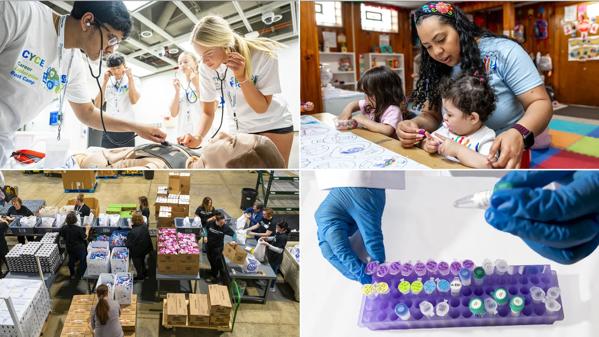
Advancing medical training and education is central to Cleveland Clinic’s commitment to serving the community. In 2024, the health system invested $357.9 million in support of education.
Education initiatives include programs that result in a degree, certificate, or the training necessary to practice medicine, or the continuing education necessary to retain licenses to practice as health professionals. Through education, Cleveland Clinic helps the public receive an advanced level of medical care and have access to highly trained health professionals in the future. The health system has 126 training programs and 2,300 residents and fellows.
Workforce education and development initiatives include the health system’s collaboration with Northeast Ohio partners to fund the Nursing Clinical Adjunct Faculty Initiative, a regional model developed to expand nursing education capacity and strengthen the future workforce. These partnerships reflect Cleveland Clinic’s leadership in workforce innovation, building sustainable pipelines in areas of local and national need.
Advancing Research and Innovation
Medical and health-related research creates knowledge that benefits the public, impacting the future of healthcare and improving the long-term wellbeing of the community. New discoveries made at Cleveland Clinic can play a vital role in addressing individuals’ health needs and patient care as a whole across the globe. In 2024, the health system invested $147.3 million in research, supporting over 3,600 active projects led by more than 5,700 salaried physicians and researchers who are committed to discovery and innovation.
“One of the primary goals of our research is to generate, develop and contribute to an ever-expanding body of medical knowledge that can be applied across various contexts,” said Serpil Erzurum, M.D., Cleveland Clinic’s Chief Research and Academic Officer. “We are committed to ensuring the knowledge gained from research is accessible to the public, enabling those around us to benefit from the insights and advancements that emerge at Cleveland Clinic.”
Supporting Community Health and Addressing Social Drivers
Cleveland Clinic understands that health is shaped by more than medical care. Social drivers of health significantly impact individuals’ health outcomes and quality of life. In 2024, Cleveland Clinic provided $28.7 million in subsidized health services, including pediatric, behavioral health, obstetric and chronic disease management programs that meet essential community needs.
In 2024, Cleveland Clinic’s total support of community health initiatives was $47 million. The health system received $34.3 million from FEMA in 2024 for costs incurred during the COVID-19 pandemic, resulting in a net support of $12.7 million.
In November 2025, Cleveland Clinic announced a $2 million gift for hunger relief efforts across the communities it serves in Ohio, Florida and Nevada. The funding will benefit nine Feeding America member food banks that share Cleveland Clinic’s commitment to addressing social drivers of health, including food insecurity. This commitment builds on a $10.4 million gift made by the health system in 2023 to implement programs to combat hunger, including a teaching kitchen, summer meals for children, food vouchers and grocery delivery, and Nourish food pantries.
Another recent community health initiative was in collaboration with Hitchcock Center for Women in Cleveland. Cleveland Clinic contributed $2.5 million to support a new 77,000 sq. ft. residential treatment and recovery facility to help double the number of clients the center serves. Project partners celebrated the completion of a $27 million expansion in Sept. 2025.
Cleveland Clinic continues to support the Lead Safe Cleveland Coalition’s lead remediation efforts, following the health system’s initial pledge of $52.5 million to the coalition in 2022. In May 2025, coalition partners held a ribbon-cutting ceremony to celebrate Lily Diaz Child Care in Cleveland as one of the first providers to achieve lead-safe clearance through the program.
“We engage with communities by listening to their needs and then investing in initiatives where we can have the greatest impact,” said Vickie Johnson, Executive Vice President and Chief Community Officer at Cleveland Clinic. “Research, education, and community support are deeply interconnected, and all contribute to our work to identify and address the health-related needs of everyone served by Cleveland Clinic.”
The entire community benefit report is available here.
Video content: This video is available to watch online.
View video online (https://cdnapisec.kaltura.com/p/2207941/sp/220794100/playManifest/entryId/1_gj6ng1xz/flavorId/1_5f3sgelj/format/url/protocol/https/a.mp4)


 Search