Locations:





Findings include vaccine elicited immune response in majority of participants
Content is property of Cleveland Clinic and for news media use only.
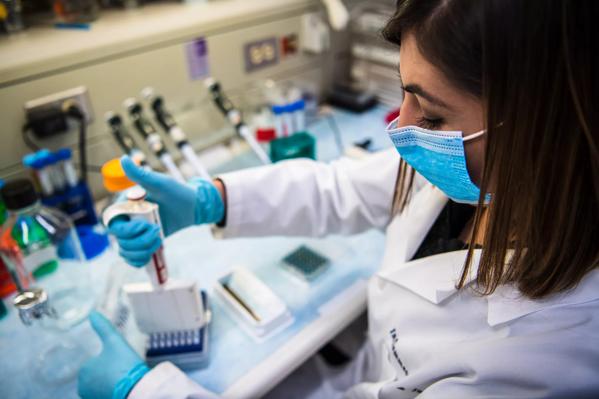
A researcher conducts a breast cancer vaccine related experiment in a lab at Cleveland Clinic.
Cleveland Clinic researchers are presenting final Phase 1 data from their novel study of a vaccine aimed at preventing triple-negative breast cancer, the most aggressive and lethal form of the disease.
The study team found that the investigational vaccine produced an immune response in the majority (74%) of all participants and was safe and well tolerated. They determined the maximum tolerated dose and described that side effects primarily consisted of mild skin inflammation at the injection site. The findings, which will inform the subsequent Phase 2 study, are being presented at the San Antonio Breast Cancer Symposium.
“Triple-negative breast cancer remains one of the most challenging forms of the disease to treat effectively,” said G. Thomas Budd, M.D., of Cleveland Clinic’s Cancer Institute and principal investigator of the study. “The results from this trial are promising, as they suggest the investigational vaccine is not only safe and well tolerated but also capable of inducing immune responses in over 70% of participants.”
Funded by the U.S. Department of Defense, the clinical trial evaluated safety and monitored immune response to the vaccine. The Phase 1 study (NCT04674306), conducted at Cleveland Clinic’s Main Campus in partnership with Anixa Biosciences, Inc., included 35 patients across three cohorts:
Launched in 2021, the trial enrolled 26 patients in Phase 1a, four in Phase 1b, and five in Phase 1c. Anixa is planning a Phase 2 study to evaluate the efficacy of the vaccine. The trial is expected to begin late next year and is projected to last approximately two to three years.
There is a great need for improved treatments for triple-negative breast cancer, which does not have biological characteristics that typically respond to hormonal or targeted therapies. Although it makes up only 10-15% of breast cancer cases, it causes a disproportionately high number of breast cancer deaths, according to the American Cancer Society. This aggressive cancer is twice as common in Black women, and accounts for 70-80% of breast tumors in patients with BRCA1 gene mutations.
The investigational vaccine is based on pre-clinical research led by the late Vincent Tuohy, Ph.D., who was the Mort and Iris November Distinguished Chair in Innovative Breast Cancer Research at Cleveland Clinic. Dr. Tuohy’s decades of groundbreaking research led to the development of this investigational vaccine.
The vaccine targets a lactation protein, α-lactalbumin, which is no longer found after lactation ceases in normal, aging breast tissues but is present in most triple-negative breast cancers. The vaccine is designed to stimulate the immune system to attack tumors if they develop.
The study is based on Dr. Tuohy’s research that showed that activating the immune system against α-lactalbumin was safe and effective in preventing breast tumors in mice. The research, originally published in Nature Medicine, was funded in part by philanthropic gifts from more than 20,000 people over the last 12 years.
“It was Dr. Tuohy’s hope that this vaccine would demonstrate the potential of immunization as a new way to combat breast cancer, and that a similar approach could someday be applied to other types of malignancies,” said Justin Johnson, Ph.D., researcher in Cleveland Clinic’s Department of Inflammation and Immunity and presenter of the study. “Our findings that the majority of participants across all three cohorts demonstrated an immune response to α-lactalbumin is an encouraging sign for the vaccine’s potential moving forward.”
Anixa is the exclusive worldwide licensee of the novel breast cancer vaccine technology developed at Cleveland Clinic. Cleveland Clinic is entitled to royalties and other commercialization revenues from the company.
Cleveland Clinic is a nonprofit multispecialty academic medical center that integrates clinical and hospital care with research and education. Founded in 1921 by four renowned physicians with a vision of providing outstanding patient care based upon the principles of cooperation, compassion and innovation, Cleveland Clinic has pioneered many medical breakthroughs, including coronary artery bypass surgery and the first face transplant in the United States. Cleveland Clinic is consistently recognized in the U.S. and throughout the world for its expertise and care. Among Cleveland Clinic’s 83,000 employees worldwide are more than 6,600 salaried physicians and researchers, and 21,900 registered nurses and advanced practice providers, representing 140 medical specialties and subspecialties. Cleveland Clinic is a 6,725-bed health system that includes a 173-acre main campus near downtown Cleveland, 23 hospitals, 300 outpatient facilities, including locations in northeast Ohio; Florida; Las Vegas, Nevada; Toronto, Canada; Abu Dhabi, UAE; and London, England. In 2025, there were 15.9 million outpatient encounters, 343,000 hospital admissions and observations, and 336,000 surgeries and procedures throughout Cleveland Clinic’s health system. Visit us at clevelandclinic.org. Follow us at x.com/CleClinicNews. News and resources are available at newsroom.clevelandclinic.org.
Editor’s Note: Cleveland Clinic News Service is available to provide broadcast-quality interviews and B-roll upon request.




 Search