Locations:





Findings from Sant'Anna School of Advanced Studies and Cleveland Clinic may pave the way for improvements in prosthetic limbs
Content is property of Cleveland Clinic and for news media use only.
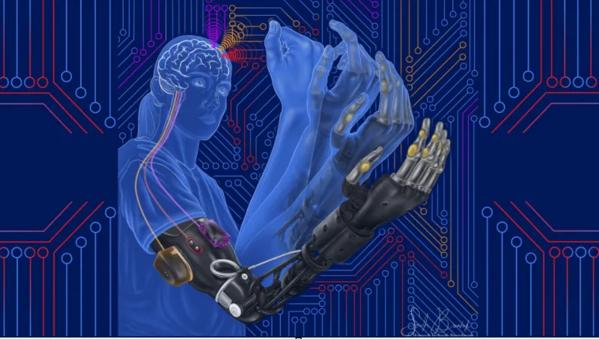
PISA, Italy, and CLEVELAND, Ohio: A research team led by Sant'Anna School of Advanced Studies in Pisa in collaboration with Cleveland Clinic has uncovered new insight into how the brain senses movement. Their findings, published in Science Advances, could potentially help improve sensation and movement for prosthetic limbs.
By combining data from the world’s only two neural-machine interfaces designed to restore kinesthetic sensation - or the sense of movement - in upper limb prosthetics, the researchers found that the brain appears to process this information not as isolated signals, but as coordinated hand grasp movement patterns, or “synergies.”
Kinesthesia, the sense of muscle movement, is essential for natural motor control. It is lost after amputation, making prostheses harder to use intuitively. Muscle vibration can be used to generate perceptions of movement, but these vibrations typically stimulate both skin and muscle at the same time, which can confuse the brain while using prosthetics.
To address this, Sant’Anna developed the myokinetic kinesthetic interface (MKkI), a new bidirectional interface for hand prostheses that uses vibrations generated by small magnets implanted in the residual forearm muscles to restore natural sensations of movement. The system was integrated with the Mia Hand robotic hand developed by the Sant'Anna spin-off company Prensilia.
The team tested the interface between the hand and the brain for six weeks in a 34-year-old Italian patient, who perceived hand opening and closing with coordinated movements, very similar to real ones.
“The myokinetic kinesthetic interface is unique because it uses a simple, minimally invasive implant to stimulate muscles without touching the skin. This approach may be the key to better understanding how human motor control works, but also how to restore movement sensation after amputation," says Federico Masiero, Ph.D., first author of the study, former Ph.D. student at Sant’Anna, and currently a postdoctoral researcher at the Munich Institute of Robotics and Machine Intelligence (MIRMI) of the Technical University of Munich (TUM).
The coordinated hand movements felt by the patient appeared similar to those felt by participants with a different kinesthetic feedback system built by researchers at Cleveland Clinic. The two prosthetic interface systems were structurally different. The one developed at Sant’Anna used implanted magnets and the other at Cleveland Clinic used surgical nerve redirection and robotics.
Even so, both kinesthetic interfaces, which function by specifically vibrating the deep muscles, produced similar perceptual results: induced movement sensations were perceived as coordinated finger movements rather than separate signals. Both research teams also observed that some sensations transmitted through their respective interfaces were perceived by the patient without their users being immediately aware of them.
Together, the teams’ findings suggest that the brain may organize movement sensation from the muscles in a more coordinated and more subconscious fashion than previously understood. This new result paves the way for more intuitive control of prostheses and may also have future applications in stroke rehabilitation, epilepsy and pain treatment.
“The ability to compare independently generated data from two very different interfaces makes these findings especially compelling," says Professor Paul Marasco, Ph.D., coordinator of the study at Cleveland Clinic. “It gives us a stronger foundation for designing therapies and devices that work with the nervous system in a more natural way, with the ultimate goal of improving outcomes for patients.”
The research outlook: toward a permanent implant
The team’s next goal is to use prior work reading out the position of implanted magnets to control the prosthesis while simultaneously writing in to the magnets with superimposed vibration to restore natural sensory perceptions. The longer-term aim is to develop a permanent implant. These current projects and the team’s earlier collaborative studies lay the groundwork for combining natural grasp sensation with intuitive motor control in people with hand loss, potentially elevating the function of an emerging generation of more human-like prosthetic devices.
“Our solution was implemented as a preliminary demonstrator: the implant was designed to last six weeks, a period we considered sufficient for an initial verification of the interface's usefulness and effectiveness. The results were very promising and prompted us to explore a permanent implantable solution, which will allow us to study the interface over much longer periods and with a larger number of participants," says Professor Christian Cipriani, the creator of the interface and coordinator of the study.
The research team behind the study
The study, coordinated by The BioRobotics Institute of the Sant'Anna School of Advanced Studies in Pisa, in collaboration with the Pisa University Hospital (AOUP) and Cleveland Clinic, was supported by European, Italian, and U.S. funding. These include the ERC projects MYKI and MYTI, the Fit For Medical Robotics and PROPRIOUSS projects funded by the Italian Ministry of University and Research, and US data originally collected under awards from the NIH Office of the Director and DARPA. The first author of the study is a researcher at the Technical University of Munich, funded by a Marie Skłodowska-Curie Action fellowship.
Cleveland Clinic is a nonprofit multispecialty academic medical center that integrates clinical and hospital care with research and education. Founded in 1921 by four renowned physicians with a vision of providing outstanding patient care based upon the principles of cooperation, compassion and innovation, Cleveland Clinic has pioneered many medical breakthroughs, including coronary artery bypass surgery and the first face transplant in the United States. Cleveland Clinic is consistently recognized in the U.S. and throughout the world for its expertise and care. Among Cleveland Clinic’s 83,000 employees worldwide are more than 6,600 salaried physicians and researchers, and 21,900 registered nurses and advanced practice providers, representing 140 medical specialties and subspecialties. Cleveland Clinic is a 6,725-bed health system that includes a 173-acre main campus near downtown Cleveland, 23 hospitals, 300 outpatient facilities, including locations in northeast Ohio; Florida; Las Vegas, Nevada; Toronto, Canada; Abu Dhabi, UAE; and London, England. In 2025, there were 15.9 million outpatient encounters, 343,000 hospital admissions and observations, and 336,000 surgeries and procedures throughout Cleveland Clinic’s health system. Visit us at clevelandclinic.org. Follow us at x.com/CleClinicNews. News and resources are available at newsroom.clevelandclinic.org.
Sant’Anna School of Advanced Studies is a public university institute - with special autonomy - working in the field of applied sciences: Economics and Management, Law, Political Sciences, Agricultural Sciences and Plant Biotechnology, Medicine, and Industrial and Information Engineering. The School promotes the internationalization of didactics and research with innovative paths in the fields of university education, scientific research and advanced training.



 Search