Locations:





Nearly all patients have achieved a functional cure
Content is property of Cleveland Clinic and for news media use only.
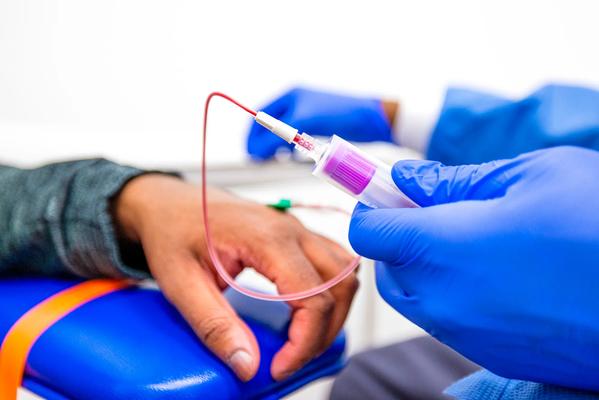
New results from a clinical trial show promising outcomes for a gene-edited treatment for severe sickle cell disease, a genetic blood disorder with few curative options.
Conducted as part of the multicenter RUBY Trial, researchers published their latest findings in the New England Journal of Medicine. Remarkably, 27 out of 28 patients did not have any painful sickle cell crises after treatment, achieving what physicians call a "functional cure."
In the trial, patients were treated with an experimental one-time gene editing cell therapy – Renizgamglogene autogedtemcel (reni-cel) – that modifies a patient’s own blood-forming stem cells to correct the mutation responsible for sickle cell disease. The novel therapy increases levels of fetal hemoglobin – which prevents red blood cells from forming into sickle-shaped cells – and improves overall hemoglobin levels, reducing complications from the disease.
“We have seen that a benefit of this CRISPR/Cas12a gene-editing technology is that there is no rejection, so it's different from traditional bone marrow transplants, which is standard treatment for sickle cell patients currently,” says Rabi Hanna, M.D., lead author and chair of the Pediatric Hematology – Oncology & Blood and Bone Marrow Transplant Division at Cleveland Clinic Children’s. “Our aim has been to achieve a functional cure to help prevent any future damage caused by sickle cell disease, and these latest results are compelling.”
The 28 patients – four of whom were treated at Cleveland Clinic Children’s – underwent a procedure where their stem cells were first collected for gene editing. They then received chemotherapy to clear their bone marrow, making room for the repaired cells which were later infused back into their body.
The results showed that most patients saw key blood cells recover within a month after treatment and by six months, average total hemoglobin levels rose to 13.8 g/dL, up from 9.8 g/dL before treatment – a level closer to what is seen in people without sickle cell disease. The average level of fetal hemoglobin (HbF) was 48.1%, and these levels remained stable over time.
Sickle cell disease is a genetic blood disorder that causes red blood cells to be misshapen like a sickle. Normal red blood cells are round and carry oxygen smoothly through blood vessels. In sickle cell disease, the abnormal cells block blood flow and break apart easily, leading to complications such as severe pain, liver and heart issues, and a shorter life span, typically in the mid-40s. Medications can help manage the disease, but a cure is possible only through a blood or marrow transplant, which has risks and often requires a sibling donor.
Cleveland Clinic has a specialized center for the care of adults and children with sickle cell. It provides comprehensive care, including treatment and support services throughout a patient’s lifetime, beginning in childhood.
The RUBY Trial is sponsored by Editas Medicine.
Cleveland Clinic Children’s is a part of the Cleveland Clinic health system and offers full medical, surgical and rehabilitative care for infants, children and adolescents. Cleveland Clinic Children’s supports 389 beds in four acute care hospitals and one post-acute specialty hospital. In addition, pediatric services are available at more than 50 outpatient clinic locations across Northeast Ohio. A staff of more than 400 full-time pediatricians and sub-specialists see more than one million pediatric visits each year and provide hospital care for 13,000 children per year. Cleveland Clinic Children’s is a non-profit, multi-specialty academic medical center integrating clinical care, research, and education. Cleveland Clinic Children’s consistently ranks among the “Best Children’s Hospitals” by U.S. News & World Report. Visit us online at www.clevelandclinic.org/childrens and on Facebook at www.facebook.com/clevelandclinicchildrens.
Cleveland Clinic is a nonprofit multispecialty academic medical center that integrates clinical and hospital care with research and education. Located in Cleveland, Ohio, it was founded in 1921 by four renowned physicians with a vision of providing outstanding patient care based upon the principles of cooperation, compassion and innovation. Cleveland Clinic has pioneered many medical breakthroughs, including coronary artery bypass surgery and the first face transplant in the United States. Cleveland Clinic is consistently recognized in the U.S. and throughout the world for its expertise and care. Among Cleveland Clinic’s 82,600 employees worldwide are more than 5,786 salaried physicians and researchers, and 20,700 registered nurses and advanced practice providers, representing 140 medical specialties and subspecialties. Cleveland Clinic is a 6,728-bed health system that includes a 173-acre main campus near downtown Cleveland, 23 hospitals, 280 outpatient facilities, including locations in northeast Ohio; Florida; Las Vegas, Nevada; Toronto, Canada; Abu Dhabi, UAE; and London, England. In 2024, there were 15.7 million outpatient encounters, 333,000 hospital admissions and observations, and 320,000 surgeries and procedures throughout Cleveland Clinic’s health system. Patients came for treatment from every state and 112 countries. Visit us at clevelandclinic.org. Follow us at x.com/CleClinicNews. News and resources are available at newsroom.clevelandclinic.org.



 Search