Locations:





Research paved way for development of widely used mental health and mood disorder treatments
Content is property of Cleveland Clinic and for news media use only.
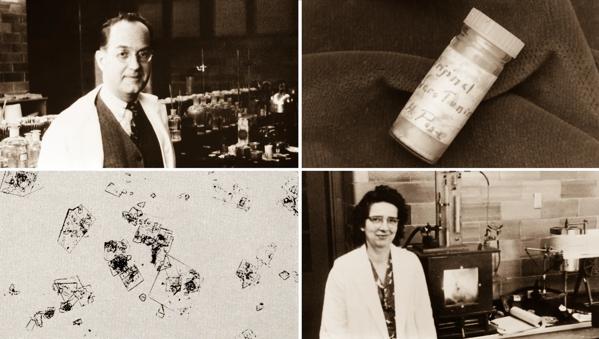
Clockwise from top left: Irvine Page, M.D., in his Cleveland Clinic lab; a vial containing the first serotonin synthesized; Arda Green, M.D., with perfusion device she used to isolate serotonin; and an illustration of crystalline serotonin.
Cleveland Clinic has been honored by the American Chemical Society with the National Historic Chemical Landmark designation for its pivotal role in the discovery of serotonin. Cleveland Clinic researchers were recognized today in a ceremony for their pioneering work in the isolation and naming of serotonin, the foundation for mental health and mood disorder treatments.
The National Historic Chemical Landmarks program recognizes seminal events in the history of chemistry.Past Landmarks include the discovery and production of penicillin, the invention of warfarin, deciphering the genetic code, and the work of notable scientific figures such as Thomas Edison and George Washington Carver.
“Cleveland Clinic’s designation as a National Historical Chemical Landmark honors our role as a pioneer in research, placing the discovery of serotonin alongside the most influential scientific achievements in medical history,” said Serpil Erzurum, M.D., Cleveland Clinic’s Chief Research and Academic Officer. “This distinction commemorates Cleveland Clinic’s fundamental contributions to science and medicine, reinforcing our more than 100-year focus on improving patient care through innovation and scientific discovery.”
In 1948, Cleveland Clinic researchers led by Irvine Page, M.D., were the first to isolate serotonin from the blood. Dr. Page and a team of visionary scientists, including Arda Green, M.D., and Maurice Rapport, Ph.D., initially believed serotonin played a role in the blood. Isolating serotonin allowed additional members of the team, like Betty Twarog, Ph.D, to study it more closely and discover that the molecule acts primarily as a neurotransmitter in the brain. Now known to play important roles throughout the body, serotonin is best recognized for its effects on mood, cognition, memory, appetite and sleep.
Their work helped establish the link between serotonin and brain function, shaping decades of neuroscience and mental health research and treatments. It also laid the groundwork for the development of selective serotonin reuptake inhibitors (SSRIs), widely used anti-depressants which increase serotonin levels in the brain to help regulate mood.
“This groundbreaking discovery transformed our understanding of the brain’s connection to behavior and emotion,” said Leo Pozuelo, M.D., chair of Psychiatry and Psychology at Cleveland Clinic. “Before serotonin was successfully isolated, the role of neurochemistry in shaping our inner lives was not yet understood. In the more than 75 years since, advances in psychopharmacology – from antidepressants to newer therapies such as ketamine and psychedelics – have continued to expand the frontiers of mental health care. We are so proud to build on the legacy of Dr. Page’s lab by promoting clinical care and research in mental health.”
A pioneering physician-scientist, Dr. Page in 1945 founded Cleveland Clinic’s first formal Research Division, the roots of what is now a global research enterprise. His work on hypertension, cardiovascular disease and serotonin shaped the integration of research and patient care.
Along with continuing to define serotonin’s role, Dr. Page’s team’s further hypertension research helped show that atherosclerosis was not simply an inevitable part of aging and strengthened the connection between diet and heart disease. He also demonstrated that hypertension could be treated and reversed. Additionally, he was an early supporter and advocate for what would become the National Academy of Medicine.
“Dr. Page coupled scientific rigor with a future-focused vision,” said Dr. Erzurum. “His leadership elevated Cleveland Clinic into a research powerhouse, insisting on meticulous chemistry in service of patient care. His influence is still felt in our guiding principles today: we’re asking bold questions, building the tools to answer them, and ensuring the answers make a difference for our patients.”
The National Historic Chemical Landmark designation will be marked with a commemorative plaque from the American Chemical Society to be hung at Cleveland Clinic Main Campus.
Cleveland Clinic is a nonprofit multispecialty academic medical center that integrates clinical and hospital care with research and education. Founded in 1921 by four renowned physicians with a vision of providing outstanding patient care based upon the principles of cooperation, compassion and innovation, Cleveland Clinic has pioneered many medical breakthroughs, including coronary artery bypass surgery and the first face transplant in the United States. Cleveland Clinic is consistently recognized in the U.S. and throughout the world for its expertise and care. Among Cleveland Clinic’s 83,000 employees worldwide are more than 6,600 salaried physicians and researchers, and 21,900 registered nurses and advanced practice providers, representing 140 medical specialties and subspecialties. Cleveland Clinic is a 6,725-bed health system that includes a 173-acre main campus near downtown Cleveland, 23 hospitals, 300 outpatient facilities, including locations in northeast Ohio; Florida; Las Vegas, Nevada; Toronto, Canada; Abu Dhabi, UAE; and London, England. In 2025, there were 15.9 million outpatient encounters, 343,000 hospital admissions and observations, and 336,000 surgeries and procedures throughout Cleveland Clinic’s health system. Visit us at clevelandclinic.org. Follow us at x.com/CleClinicNews. News and resources are available at newsroom.clevelandclinic.org.
Editor’s Note: Cleveland Clinic News Service is available to provide broadcast-quality interviews and B-roll upon request.







 Search