Locations:





 Search
Single-incision robotic surgery may decrease morbidity and recovery time for patients
Content is property of Cleveland Clinic and for news media use only.
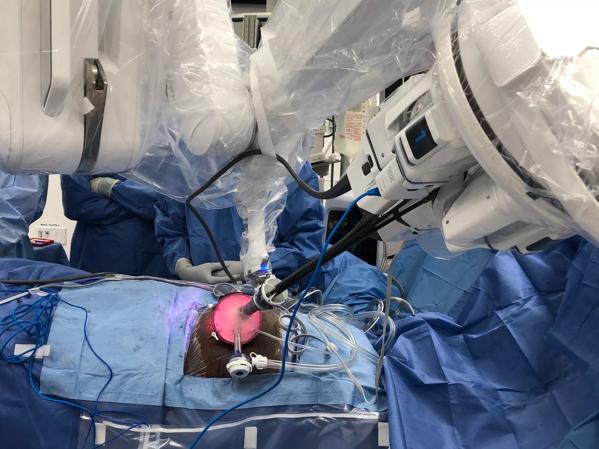
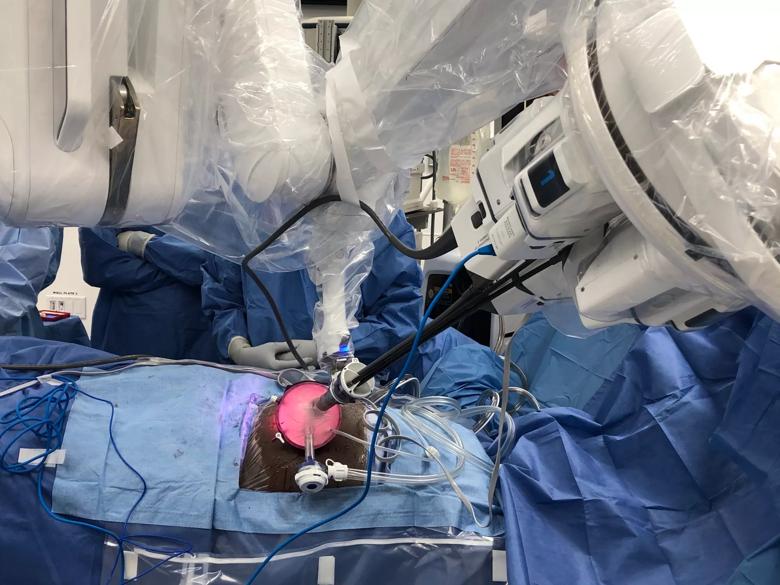
Image content: This image is available to view online.
View image online (https://assets.clevelandclinic.org/transform/8c619352-c213-4f43-bdba-903cb78fc175/p-robot-2-IMG_0404-scaled_jpeg)
Cleveland Clinic surgeons perform the world’s first robotic single-port kidney transplant.
Cleveland Clinic is the first hospital in the world to successfully perform a robotic single-port kidney transplant, which enables all surgical instruments and the donor kidney to be placed through one small abdominal incision.
The Glickman Urological & Kidney Institute surgical team included Jihad Kaouk, M.D., director of the Center for Robotic and Image Guided Surgery; Alvin Wee, M.D., surgical director of Renal Transplantation; Mohamed Eltemamy, M.D.; David Goldfarb, M.D.; and Eric Miller, M.D. These surgeons combined their collective expertise in minimally invasive, robotic, and kidney transplant surgery to successfully complete the operation in October.
Dr. Kaouk and his team were the first in the country to successfully perform robotic single-port prostatectomy and kidney cancer surgery in September 2018. This latest surgical technique provides evidence that the single-port approach is feasible not only for patients with cancer, but also for patients who are in need of a kidney transplant.
“The aim was not only to make a smaller incision, but also to minimize the area in which the operation was performed by limiting the number of cuts inside the patient,” said Dr. Kaouk. “This resulted in minimal post-operative pain and no opioids needed after surgery.”
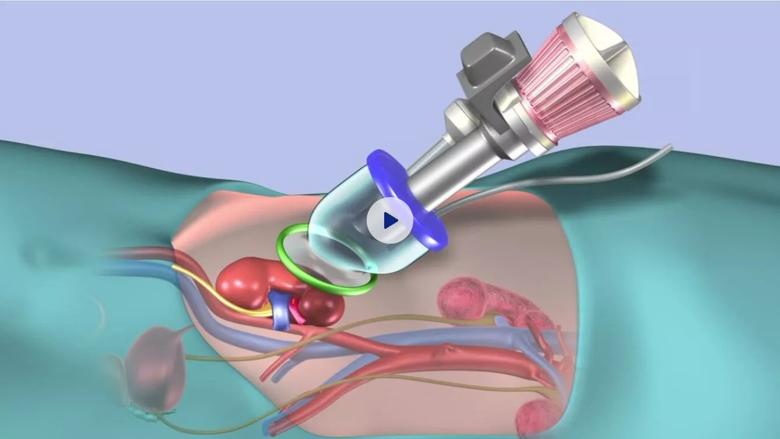
Image content: This image is available to view online.
View image online (https://assets.clevelandclinic.org/transform/acedbc04-3df9-4957-b287-d076c2690a8a/idney-animation-pic_jpg)
Click image to view or download an animation of the surgery.
The robotic single-port platform may provide an alternative option for the appropriate patient, including patients with obesity or challenging anatomy. During the operation, the surgical team created a small four-centimeter incision on the patient’s abdomen. The surgeon then used the single-port robot to prepare the site for the donor kidney, connect the blood vessels, and lastly reconstruct the urinary drainage, before suturing the incision.
“The robotic single-port approach is very promising,” said Dr. Wee. “We are looking forward to continuing to refine this technique and our team is optimistic that this minimally invasive surgery can add to our range of options for kidney transplantation.”
Emilio Poggio, M.D., medical director of the Kidney Transplant Program, said, “Kidney transplantation continues to be the best treatment option for patients with end-stage kidney disease and it is a very dynamic field where innovation brings new opportunities for personalized care. As such, this first robotic single-port kidney transplant adds cutting edge practice to the care of these patients.”
Georges Haber, M.D., chair of urology in the Glickman Urological and Kidney Institute, said, “Kidney transplantation is a life-changing event for patients, many of whose quality of life has been negatively impacted by having to receive dialysis three times a week while waiting for a donor. This technique allows patients to regain their quality of life more rapidly. Using the latest technology to help our patients live a full life is the true spirit of innovation which we foster within the department of urology here at Cleveland Clinic.”
Dr. Kaouk is a paid speaker for Intuitive Surgical, Inc.
Cleveland Clinic is a nonprofit multispecialty academic medical center that integrates clinical and hospital care with research and education. Founded in 1921 by four renowned physicians with a vision of providing outstanding patient care based upon the principles of cooperation, compassion and innovation, Cleveland Clinic has pioneered many medical breakthroughs, including coronary artery bypass surgery and the first face transplant in the United States. Cleveland Clinic is consistently recognized in the U.S. and throughout the world for its expertise and care. Among Cleveland Clinic’s 83,000 employees worldwide are more than 6,600 salaried physicians and researchers, and 21,900 registered nurses and advanced practice providers, representing 140 medical specialties and subspecialties. Cleveland Clinic is a 6,725-bed health system that includes a 173-acre main campus near downtown Cleveland, 23 hospitals, 300 outpatient facilities, including locations in northeast Ohio; Florida; Las Vegas, Nevada; Toronto, Canada; Abu Dhabi, UAE; and London, England. In 2025, there were 15.9 million outpatient encounters, 343,000 hospital admissions and observations, and 336,000 surgeries and procedures throughout Cleveland Clinic’s health system. Visit us at clevelandclinic.org. Follow us at x.com/CleClinicNews. News and resources are available at newsroom.clevelandclinic.org.
Editor’s Note: Cleveland Clinic News Service is available to provide broadcast-quality interviews and B-roll upon request.