Locations:




Dr. Margot Damaser’s new device improves on her “Fitness tracker for the bladder” and measures both pressure and volume in preclinical models. Her milestone 200th paper was published in IEEE Sensors Journal. The Urodynamics Monitor (UM) was developed with support from Cleveland Clinic Innovations.
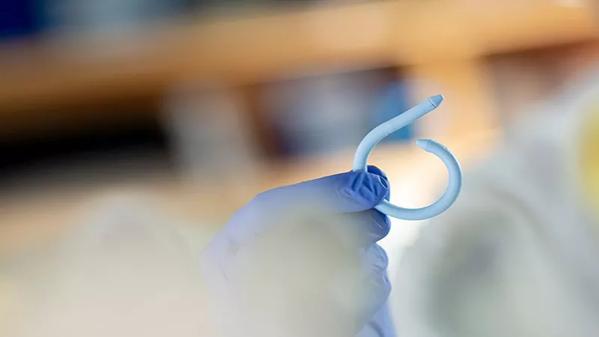
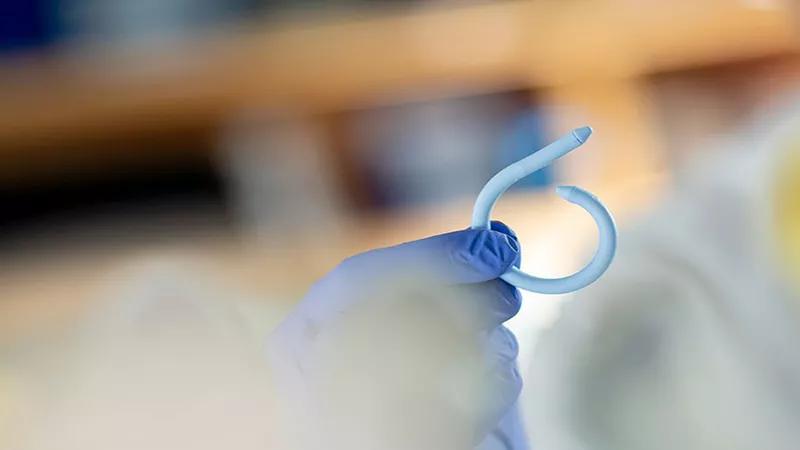
Image content: This image is available to view online.
View image online (https://assets.clevelandclinic.org/transform/5f3f7926-43f0-4029-a54a-e654584e26b0/uromonitor)
Pictured: Dr. Margot Damaser's hand holds up her Urodynamics Monitor, a device that helps track and diagnose health problems in the bladder.
When Margot Damaser, PhD, observed her first urodynamics procedure she knew the field needed to change and "do better." Almost 30 years and over 200 papers later she continues to publish and innovate better, patient-friendly ways to diagnose and treat sensitive conditions that impact millions of people worldwide, making her dream a reality.
In her milestone 200th paper published in IEEE Sensors Journal, Dr. Damaser and her collaborators developed a strategy for adding new abilities to their "fitness tracker for the bladder," the Urodynamics Monitor (UM). The UM, a wireless, catheter-free device currently being trialed in humans, is designed to be a less invasive solution for gathering diagnostics for conditions like urinary incontinence.
The UM, and associated patents and technology, were licensed to a startup with hopes of FDA approval for commercialization and full clinical use in the near future. “And that will be the most rewarding thing is being able to know that it’s being used in clinics and helping patients,” says Dr. Damaser.
The UM is a success from Dr. Damaser's long-standing research program, which focuses on improving the way physicians measure, diagnose and treat conditions that cause symptoms like urinary or fecal incontinence, and pelvic issues including pelvic floor dysfunction or prolapse. Urodynamic tests involving catheters can be painful or embarrassing for some patients, Dr. Damaser says.
The conditions needed to perform these tests and collect information about bladder function in the clinic are far removed from an individual's experiences in and out of the restroom, she added, so data they collect may not reflect the issues these patients face daily.
"Make no mistake, the urodynamics we do here are the best and most advanced methods we have," Dr. Damaser says. "But the benchmark for best hasn't changed in over 20 years. The way we diagnose problems in other organs has evolved so much to be more comfortable and less invasive. When it comes to the bladder, we can do so much better."
Basic research is critical to understanding how to improve medical procedures for all bodies. At the start of her scientific career, Dr. Damaser says urologists and researchers were primarily studying issues that affected men. Urinary incontinence problems caused by childbirth and menopause were overlooked.
"The lack of research into female urinary problems meant my gynecologist friends and colleagues had few options to offer their patients, so I decided to do the research myself," she says. "The thing is that even though the problems were framed as women's health issues, urodynamics tests are given to all genders. Researching better solutions is beneficial to everyone."
Dr. Damaser's most recent paper describes a device that can measure bladder pressure and volume, developed with Steve Majerus, PhD, Assistant Professor of Electrical, Computer and Systems Engineering at Case Western Reserve University and Dennis Borbeau, PhD, Assistant Professor of Physical Medicine & Rehabilitation at MetroHealth Medical Center.
Preclinical tests show that the new wireless device continually monitors and transmits data about the pressure and volume of the bladder without interfering with daily activities. Since the UM can currently only measure bladder pressure, the team now plans to integrate the device into the UM.
Along with adding additional diagnostics, the UM team are also working on giving the device more abilities to diagnose and treat disorders that cause urinary incontinence by mapping nerves throughout the bladder electrically stimulating them.
"Our Cleveland Clinic team includes engineers and physicians who help make these devices that are both functional and physically comfortable. Their expertise is essential," Dr. Damaser says. "Collaboration across disciplines – including perspectives from physicians using these devices directly with patients – is what allows us to make such great strides in patient care."
Dr. Damaser recently shared her background, goals, challenges, and advice for new inventors in the Inventor Chronicle “Keeping the Faith in the Inventor Journey”.
Video content: This video is available to watch online.
View video online (https://www.youtube.com/embed/55CFcXDpGTk?si=qjsk61G8XGqp27XQ)








 Search