Locations:




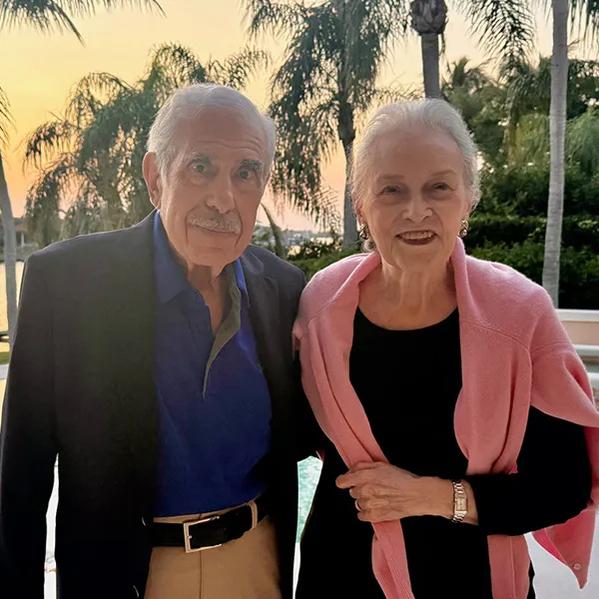
Jack and Mary Weisbaum
There’s a certain serendipity to Jack and Mary Weisbaum’s association with Cleveland Clinic Florida.
The relationship began in 2013 when Jack joined the Indian River Hospital Board of Directors. He had just retired from BDO USA, a large accounting and consulting firm, where he’d served most recently as its CEO. Jack worked tirelessly on the hospital board of directors for six years, primarily as treasurer, ending his term as the medical center became a full member of the Cleveland Clinic in 2019. Jack served on the selection committee responsible for the union.
Since 2008, Jack and his wife, Mary, also were actively involved in the Indian River Medical Center Foundation’s Eagle Society. Established almost 40 years ago, the Eagle Society recognizes donors who give more than $10,000 to the Foundation, which supports the hospital, locally.
“Prior to that time, I didn’t know much about the hospital,” admits Jack. “I was, thankfully, in good health and didn’t worry too much about needing a hospital.” He adds: “What I did hear about the hospital at that time, unfortunately, was negative. A lot of people just did not have a good view of it.” He did his own homework and observed that while a lot of positive things were occurring, community members were unaware of them.
In an effort to improve communication and the community’s perception of the hospital – and recruit more donors – Jack and other “Eagles” reached out to neighbors to share hospital strengths and needs. They also encouraged people to participate in hospital tours, health lectures, and social events with medical staff.
“It was just a neighborly thing ... a way to get to know people and learn more.” Jack recalls thinking at the time, “We were making an investment in our own future.” But he couldn’t have predicted that the hospital he believed in so strongly would save his wife’s life – and arguably his own life, too.
Three of the hospital’s earliest and most significant innovations are the Scully-Welsh Cancer Center; the Welsh Heart Center, featuring a novel lifesaving stroke treatment; and the Department of Gastroenterology, Hepatology and Nutrition and Indian River Hospital Scully Endoscopy Center. The couple chose to focus much of their giving in these areas, in addition to supporting other capital and programmatic needs across the hospital.
“It’s gratifying for us to see all these improvements benefiting community members,” Jack says. Never, however, did he or Mary expect to benefit so personally or in such life-altering ways.
It was the gastroenterology team that quickly diagnosed and treated Mary in 2018 when she arrived by ambulance to the ER presenting ischemic colitis, an inflammation in the colon that begins in the circulatory system. “They saved my life,” she maintains. “I was in excruciating pain, unable to breathe and very scared.” Remarkably, notes Jack, the medical team was able to stabilize Mary, cure an infection and treat her condition without surgery.
Three years later, Jack was diagnosed with multiple myeloma. “When I was admitted to the hospital, I was 5’9” and weighed 178 pounds,” he says. “When I came out, I was just about 5’6” and weighed 120 pounds. It wasn’t good.”
Jack is especially appreciative of and impressed by the seamless interaction between all the members of his medical team, both within and outside of Indian River Hospital. He started receiving infusions at the Scully-Welsh Cancer Center about four years ago, while continuing to also receive oncology care elsewhere. “The people are absolutely fantastic,” he gushes. To show his appreciation, he treats the Scully-Welsh caregivers to pizza parties every so often. It means a great deal to him and other cancer patients to get the treatments they need, close to home.
The Weisbaum’s fortuitous story doesn’t end there. During the course of Jack’s cancer treatments, he also would benefit from an aortic valve replacement and pacemaker implant. “The results are great,” Jack says. “I’m still here and I’m strong.” At 85, he’s back up to 150 pounds and works out three to five days a week.
“The advancements Cleveland Clinic has made are absolutely amazing. They have a great staff,” Jack says. He believes communication has improved considerably, crediting the hospital, foundation and hospital district leadership teams. “But there is no better report card I can give than what they did for Mary and me, personally.”
 Search