Locations:




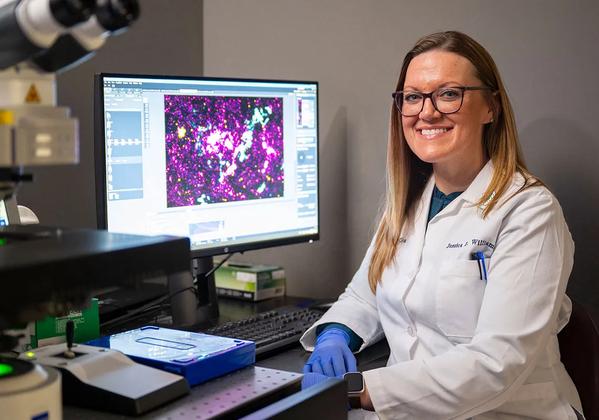
Jessica Williams, PhD, Associate Professor in the Department of Neurosciences at Cleveland Clinic Research
March is Multiple Sclerosis (MS) Awareness Month. As a reader of INbox, you may already know that MS is a chronic neurological disease in which the immune system mistakenly attacks the protective coating around nerve fibers, disrupting central nervous system function and causing a wide range of symptoms. Worldwide, approximately three million people suffer from MS.
Jessica Williams, PhD, is an Associate Professor in the Department of Neurosciences at Cleveland Clinic Research. Her lab studies the interplay between the immune and central nervous systems during MS.
Although there are medications that work well at calming the immune system during the early form of the disease, there are no effective treatments for the more advanced, progressive stages of MS.
MS causes various types of lesions in the brain and spinal cord. In the progressive stages of MS, a “chronic active lesion” is common. These lesions have a unique pattern and represent a kind of trapped inflammation that traditional anti-inflammatory drugs can’t easily reach.
Dr. Williams' research is focused on understanding these stubborn lesions — if we can find a way to treat them, we may finally have a path to slowing or stopping progressive MS.
2025 Discoveries Sparked Support
Most MS research has centered on the outer rim of lesions, long considered the primary site of activity. Dr. Williams and her team found something unexpected: the core of the lesion is not dormant as once believed, but actively involved in the disease process.
In addition, her team discovered more about the functions of astrocytes – star-shaped cells in the brain and spinal cord that play key roles in maintaining brain function and structure. Her lab's research revealed that astrocytes may have more beneficial functions in the core relative to other lesion areas, likely because they are trying to protect axons (parts of nerve cells that carry electrical signals from one cell to another) and contain the damage.
Last June, in light of this groundbreaking work, Dr. Williams' team received a generous philanthropic grant from the Mayer Foundation, one of the few private foundations offering substantial awards exclusively for investigators driving MS breakthroughs. The foundation makes strategic investments in early-stage MS research, gravitating toward efforts that can lead to important advancements in treatment or move the world closer to a cure.
Foundation Prioritizes Real Potential
“We prioritize projects with real potential to improve treatment, so we look to partner with highly reputable institutions that are leading the field," says Sarah Kalter, Mayer Foundation CEO and Executive Director. “We’ve had a relationship with Cleveland Clinic for several years because it is one of the premier institutions in neurology, and we know the people there are always top-tier.”
“The Mayer Foundation provided us with funds to expand our research and analyze more patient samples, additional points of interest within the lesions as well as additional proteins that may be of interest,” Dr. Williams says. “This strategy is one that will reveal many different mechanisms that may have the potential to either uncover novel therapeutic avenues, or down the road identify potential biomarkers which may lead to earlier treatment.”
“We feel that it is very important to support world-class researchers like those working in Dr. Williams' lab,” says Ms. Kalter. “We understand how challenging the road is for researchers to enter and remain in this field, because it’s a catch-22: researchers need results to secure funding, but they need funding to produce results.”





 Search