Locations:





One-time infusion of investigational CRISPR-Cas9 therapy found to safely reduce LDL cholesterol by 52.5% and triglycerides by 47.8% 12 months after initial treatment
Content is property of Cleveland Clinic and for news media use only.
A Cleveland Clinic Phase 1, first-in-human clinical trial has shown that a one-time infusion of a gene-editing therapy using CRISPR-Cas9 was effective and safe in reducing LDL (“bad”) cholesterol and triglycerides in people with medication-resistant lipid disorders through one-year of follow-up with all doses.
The trial, which included 15 patients, aimed to see if the reductions in LDL cholesterol and triglycerides previously reported after two months would persist for 12 months. After 12 months, patients who were treated with the highest dose saw a 52.5% lowering from baseline in LDL cholesterol, and a 47.8% reduction in triglycerides. There were no serious adverse events related to the therapy during the one-year follow-up.
The trial results were presented at the 2026 European Society of Cardiology annual meeting and simultaneously published in the New England Journal of Medicine.
“Building upon the initial data presented in November 2025, the durability of the lipid-lowering effect was impressive,” said Cleveland Clinic cardiologist Luke Laffin, M.D., first author of the study.“It is encouraging that there were no serious safety events related to CTX310 in the trial and in the year following treatment. We look forward to continuing to investigate this therapy in a larger number of patients.”
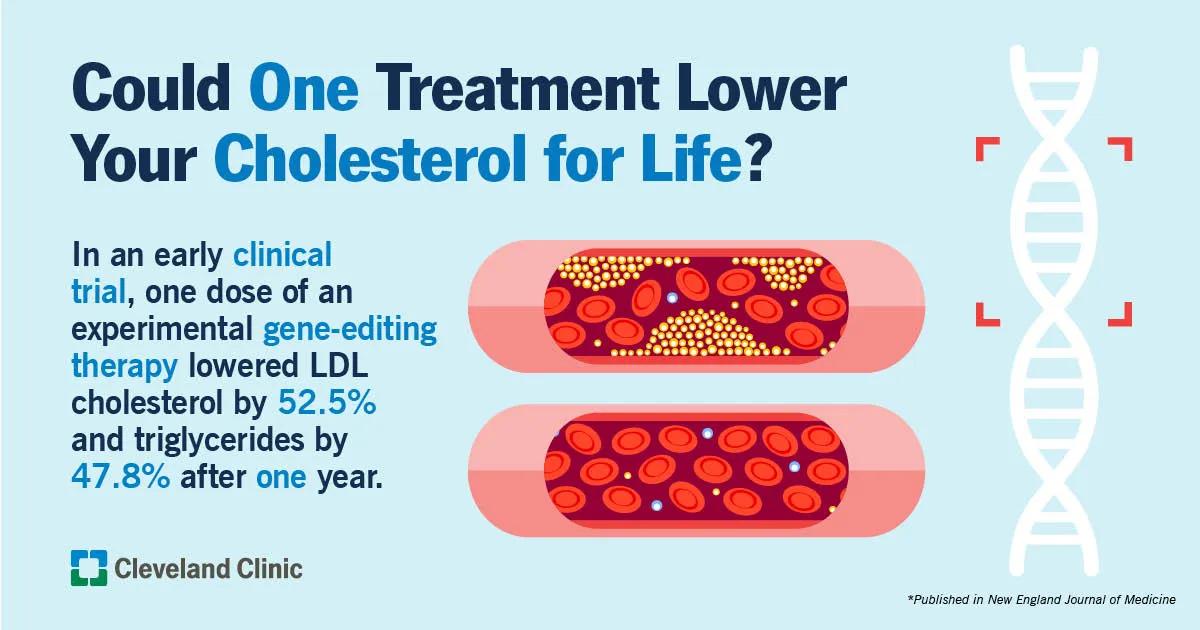
Image content: This image is available to view online.
View image online (https://assets.clevelandclinic.org/transform/3c736bac-1b7b-42fc-be80-6d9c3cd7dbd3/crispr-laffin)
CRISPR-Cas9 is a gene-editing technology that can be used to modify or correct specific regions of a person’s DNA to treat serious diseases.
This trial tested CTX310, an experimental CRISPR-Cas9 gene-editing treatment that is delivered as a one-time infusion. CTX310 carries the CRISPR editing mechanism into the liver, where it switches off a gene called ANGPTL3. Turning off this gene can lower LDL cholesterol and triglycerides, which are both linked to heart disease.
During the trial, CTX310 was administered at doses from 0.1 to 0.8 mg/kg during the single infusion, after pre-treatment with corticosteroids and antihistamines. Participants were monitored for safety of the treatment, and the effects of this gene therapy on ANGPTL3, LDL cholesterol and triglyceride levels. CTX310 reduced both LDL cholesterol and triglycerides by approximately 50% on average at the highest dose 12 months after the treatment.
The study participants were monitored for one year following the trial, with additional long-term safety follow-up planned for the next 15 years, as recommended by the FDA for all gene-editing therapies.
The study was funded by CRISPR Therapeutics AG; Zug, Switzerland.
Dr. Laffin's institution has received research funding from Crispr Therapeutics.
Cleveland Clinic is a nonprofit multispecialty academic medical center that integrates clinical and hospital care with research and education. Founded in 1921 by four renowned physicians with a vision of providing outstanding patient care based upon the principles of cooperation, compassion and innovation, Cleveland Clinic has pioneered many medical breakthroughs, including coronary artery bypass surgery and the first face transplant in the United States. Cleveland Clinic is consistently recognized in the U.S. and throughout the world for its expertise and care. Among Cleveland Clinic’s 83,000 employees worldwide are more than 6,600 salaried physicians and researchers, and 21,900 registered nurses and advanced practice providers, representing 140 medical specialties and subspecialties. Cleveland Clinic is a 6,725-bed health system that includes a 173-acre main campus near downtown Cleveland, 23 hospitals, 300 outpatient facilities, including locations in northeast Ohio; Florida; Las Vegas, Nevada; Toronto, Canada; Abu Dhabi, UAE; and London, England. In 2025, there were 15.9 million outpatient encounters, 343,000 hospital admissions and observations, and 336,000 surgeries and procedures throughout Cleveland Clinic’s health system. Visit us at clevelandclinic.org. Follow us at x.com/CleClinicNews. News and resources are available at newsroom.clevelandclinic.org.
Editor’s Note: Cleveland Clinic News Service is available to provide broadcast-quality interviews and B-roll upon request.






 Search