Locations:





MENtion It survey shows that 74% of men don’t trust health information shared by influencers, yet 39% admit they have tried a health or wellness trend after seeing it on social media
Content is property of Cleveland Clinic and for news media use only.
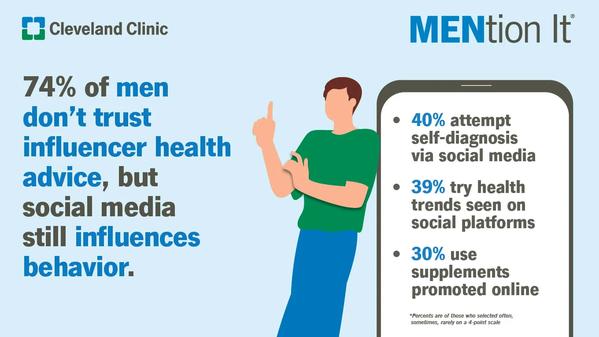
A new Cleveland Clinic survey reveals that despite some men not trusting what they see online, they are letting social media influence their behaviors.
The survey is part of Cleveland Clinic’s 11th annual MENtion It® campaign, which aims to encourage men to talk more openly about their health. This year’s survey examined men’s health in the age of social media trends and online influencers.
“So much about men’s health has been in the national conversation recently, including male fertility rates, testosterone replacement therapy, and the viral health-maxxing trends of everything under the sun,” said Petar Bajic, M.D., director of the Men’s Health Section at Cleveland Clinic’s Glickman Urological Institute. “We wanted to get a better idea of the influence and emotional impact that social media can have on men and if it’s changing their health habits and attitudes.”
The national survey of over 1,000 U.S. men found that 74% rarely or never trust health information shared by influencers, yet 39% admit they have tried a new diet or wellness trend after seeing it on social media.
The survey illustrated the idea that while social media can motivate men to improve their health, it can also fuel pressure and comparison. After seeing content on social media:
Additionally, the survey results highlight the potential danger in using the internet to replace seeing a health care professional. Two in 5 men (40%) say they attempt to self-diagnose based on information found on social media*, and nearly one-third of men (30%) use supplements or performance enhancers promoted on social media*, which can be dangerous if the user is not seeing a medical professional to get a diagnosis and prescription.
When it comes to men’s health topics that have been trending in the news, the survey showed that myths about testosterone and men’s fertility are still very prevalent.
The survey also revealed misinformation surrounding negative lifestyle habits and their effects on men’s health. According to the survey, many men are unaware that the following lifestyle behaviors can affect sexual performance and/or cause erectile dysfunction:
“We learned that American men are becoming more engaged in their health, but they're increasingly navigating a landscape shaped by social media, misinformation and self-directed care,” said Dr. Bajic. “We want to remind men that being proactive with your health by exercising and getting regular screenings, vaccinations and exams can help prevent many health problems or catch them in curable stages.”
*Percentages are of those who selected "often," "sometimes," "rarely" on a 4-point scale
Methodology
All figures, unless otherwise stated, are from YouGov Plc.Total sample size was 1135 men. Fieldwork was undertaken between 11th - 14th June 2026.The survey was carried out online. The figures have been weighted and are representative of all US men (aged 18+).
Cleveland Clinic is a nonprofit multispecialty academic medical center that integrates clinical and hospital care with research and education. Founded in 1921 by four renowned physicians with a vision of providing outstanding patient care based upon the principles of cooperation, compassion and innovation, Cleveland Clinic has pioneered many medical breakthroughs, including coronary artery bypass surgery and the first face transplant in the United States. Cleveland Clinic is consistently recognized in the U.S. and throughout the world for its expertise and care. Among Cleveland Clinic’s 83,000 employees worldwide are more than 6,600 salaried physicians and researchers, and 21,900 registered nurses and advanced practice providers, representing 140 medical specialties and subspecialties. Cleveland Clinic is a 6,725-bed health system that includes a 173-acre main campus near downtown Cleveland, 23 hospitals, 300 outpatient facilities, including locations in northeast Ohio; Florida; Las Vegas, Nevada; Toronto, Canada; Abu Dhabi, UAE; and London, England. In 2025, there were 15.9 million outpatient encounters, 343,000 hospital admissions and observations, and 336,000 surgeries and procedures throughout Cleveland Clinic’s health system. Visit us at clevelandclinic.org. Follow us at x.com/CleClinicNews. News and resources are available at newsroom.clevelandclinic.org.
Editor’s Note: Cleveland Clinic News Service is available to provide broadcast-quality interviews and B-roll upon request.






 Search