Locations:





MENtion It survey finds social media can motivate men to improve their health while fueling misconceptions, despite growing awareness of misinformation online
Men are becoming more engaged with their health, but they’re increasingly navigating a landscape shaped by social media, misinformation and self-directed care. A new Cleveland Clinic survey explores how these influences are shaping the way men think about and manage their health.
The survey is part of Cleveland Clinic’s 11th annual MENtion It® campaign, which aims to encourage men to talk more openly about their health. This year’s focus examines the role of social media trends and online influencers, while looking at areas that included myths and misconceptions around male fertility and testosterone use, the influence of social media on health decisions, and how men are approaching their overall health and well-being.
“Taking a proactive approach to your health, from making healthy lifestyle choices to keeping up with recommended screenings and regular check-ups, can help prevent health problems or identify them early, when they may be easier to treat,” said Chad Ritch, M.D., Division Chair of Urology, Cleveland Clinic Florida Market. “We want to help break down the stigma and misconceptions that can keep men from prioritizing their health. Taking care of yourself starts with being willing to have conversations, seeking the care you need, and making your well-being a priority.”
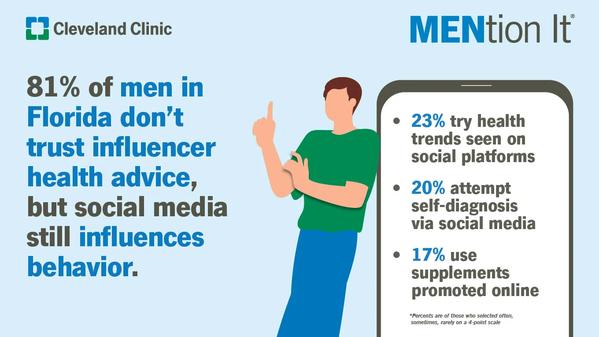
The statewide survey of 402 Florida men ages 18 and older found that, while most men remain skeptical of health information on social media, what they see online can still influence real-world health decisions. While only 16% follow or try health advice from social media users, most men (81%) rarely or never follow or try health or medical advice from influencers who are not healthcare professionals.
Despite this skepticism, social media is still influencing how men make decisions about their health. One-fifth have attempted to self-diagnose based on information found on social media, and 23% have tried new diets or wellness trends after seeing them on social media. Additionally, 17% report obtaining supplements or medications they saw online without first consulting a healthcare professional.
These findings indicate that social media can motivate men (67%) to improve their health, but it can also have negative effects. Nearly half (46%) say they feel concerned about their health after seeing health-related content on social media, while 31% compare their bodies, fitness levels, or overall health to others online.
This exposure can also contribute to misconceptions about men’s health, even as awareness grows around the prevalence of misinformation online. For example, nearly 3 in 10 (28%) men incorrectly believe erectile dysfunction is a natural part of aging, while 17% incorrectly believe testicular cancer is most common in men over age 50. At the same time, 14% of men say snoring is harmless and isn’t an indication of health issues, despite its known health risks, and one in 10 incorrectly believe taking supplements carries no health risks.
Overall, men are rejecting some of the stigma surrounding mental health, but traditional attitudes remain. Only 14% believe talking about mental health struggles makes men appear weak, while the top barriers to seeking support include:
Misconceptions also persist when it comes to fertility and testosterone. While men may understand that certain factors can affect fertility, 56% recognize that lifestyle choices can impact sperm quality. Nearly three in 10 (28%) men believe tight clothing can impact sperm quality, while nearly two in 10 (18%) believe electronic devices near the lap can have the same effect.
Additionally, 35% believe testosterone therapy can boost sexual performance, while nearly three in 10 (28%) believe testosterone therapy could make men feel younger. Nearly one-fourth (24%) of men also say testosterone therapy could help them feel better about their physical appearance. One in five men believe that feeling more tired than usual could indicate low testosterone.
Despite these pressures, most men still prefer to place their trust in doctors and healthcare professionals over AI when it comes to health advice. Only 15% of men trust that AI would provide proper guidance if they asked questions about sexual health, while just 7% would choose AI over a healthcare professional for sexual health issues because of its convenience.
“We learned that despite the myths and misconceptions surrounding men’s health, men still trust the media and even AI for health information,” said Dr. Ritch. “This presents an opportunity to continue developing resources, like Cleveland Clinic’s campaign, that raise awareness around men’s health. Increasing awareness is an important first step toward encouraging men to take a more proactive approach to their health.”
To learn more, visit: https://health.clevelandclinic.org/mention-it.
Methodology
All figures, unless otherwise stated, are from YouGov Plc. Total sample size was 402 Florida men. Fieldwork was undertaken between 11th - 23rd June 2026. The survey was carried out online. The figures have been weighted and are representative of all Florida men (aged 18+).
About Cleveland Clinic Florida Market
Cleveland Clinic in Florida is a nonprofit multi-specialty healthcare provider that integrates clinical and hospital care with research and education. The Florida market includes Cleveland Clinic Weston Hospital, Cleveland Clinic Indian River Hospital, Cleveland Clinic Martin North Hospital, Cleveland Clinic Martin South Hospital and Cleveland Clinic Tradition Hospital, as well as 40 outpatient centers across Broward, Palm Beach, Martin, St. Lucie and Indian River counties. An integral part of Cleveland Clinic, the Florida market employs approximately 12,000 caregivers and operates a 1,100-bed health system, where exceptional patient care is rooted in a mission of caring for life, researching for health, and educating those who serve. In 2025, caregivers across the Florida market provided more than 2.7 million patient encounters.
Learn more at www.ClevelandClinicFlorida.org. Stay connected by following us on LinkedIn, Facebook, X and Instagram, and visit the Florida Newsroom for the latest updates.







 Search