Locations:


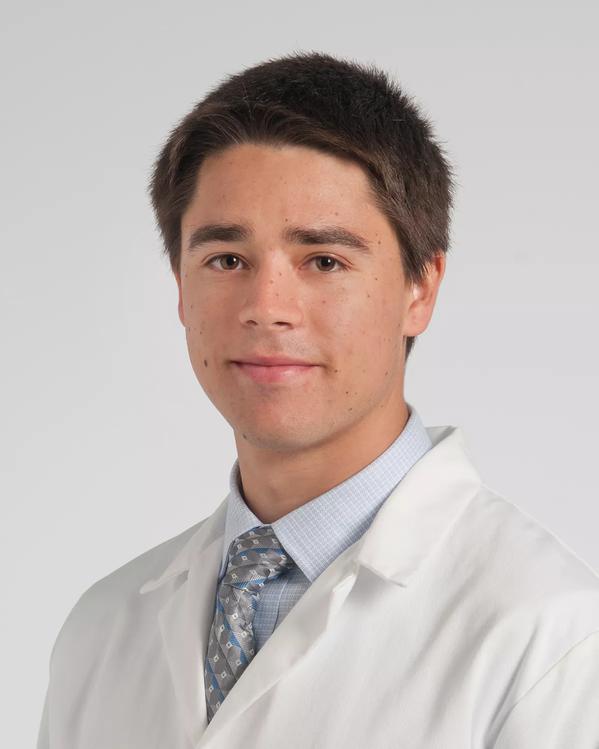
Daniel Santana (’22) doesn’t recall a “defining moment” that sparked his interest in biomedical engineering. Instead, he considers his path to be aligned with his character. “At its core, biomedical engineering involves identifying problems and making devices that can solve them,” he says. “I’ve always been somebody who likes to know how things work and who likes to use and build tools.”
Surgery, another of Daniel’s interests, has a physically grounded understanding that appeals to him in a similar way. His passion for both practices, and their overlap, is what caused him to take on an MS in Biomedical Engineering, in addition to his MD, from Case Western Reserve University. Among the advantages of becoming a surgeon with an engineering background, Daniel explains, is that one can be involved with both the design and application of medical devices.
In June, he successfully defended his thesis, entitled “Evaluation of a Composite Photothermal, D-Amino Acid Hydrogel for the Eradication of Bacterial Biofilms in a Rabbit Model of Prosthetic Joint Infection.” The full-time, year-long investigation, completed under Associate Professor of Surgery Nicolas Piuzzi, MD, explored implications of total joint replacement and adult orthopaedic reconstruction surgery.
Daniel’s captivation with orthopaedics seemed to be another logical conclusion given his interests: The field is distinct for its frequent use of surgical devices, and it aligns with his active lifestyle. “The goal of nearly any orthopaedic procedure is to allow people to be active again, or at least to minimize pain when you’re moving around,” he says.
Prior to moving to Cleveland, Daniel spent much of his life further east, especially in areas of higher elevation and increased snowfall. A native of Brookhaven, NY, Daniel recalls taking trips upstate and learning how to ski at the age of 8. When he attended Dartmouth College for his undergraduate studies, he immersed himself in more winter sports like snowboarding, rock climbing and backcountry skiing.
Since Ohio isn’t the most ideal location for climbing, Daniel has taken a few trips out of state since he’s been in medical school. Among his favorites are Red River Gorge in Kentucky, Red Rock Canyon in Nevada and Mount Washington in New Hampshire, which he used to frequent while studying at Dartmouth.
Another of Daniel’s favorite pastimes is running, and he enjoys the trails in Cuyahoga Valley National Park. Recently, he ran the entire length of the park’s Buckeye Trail, a 36-mile trek. “That was quite fun,” he recalls. “I spent a lot of time running in Cuyahoga Valley before then to make sure I knew all the trails before I did it all at once.”
In terms of a career goal, Daniel can see himself in various roles – academic research, surgery or medical device consultation. In the near future, however, he is looking forward to residency and fellowships to come after earning his MD in May 2022.



 Search