Locations:




 Search
A music conductor who has Parkinson's disease shares how a new smart deep brain stimulation procedure has changed his life.
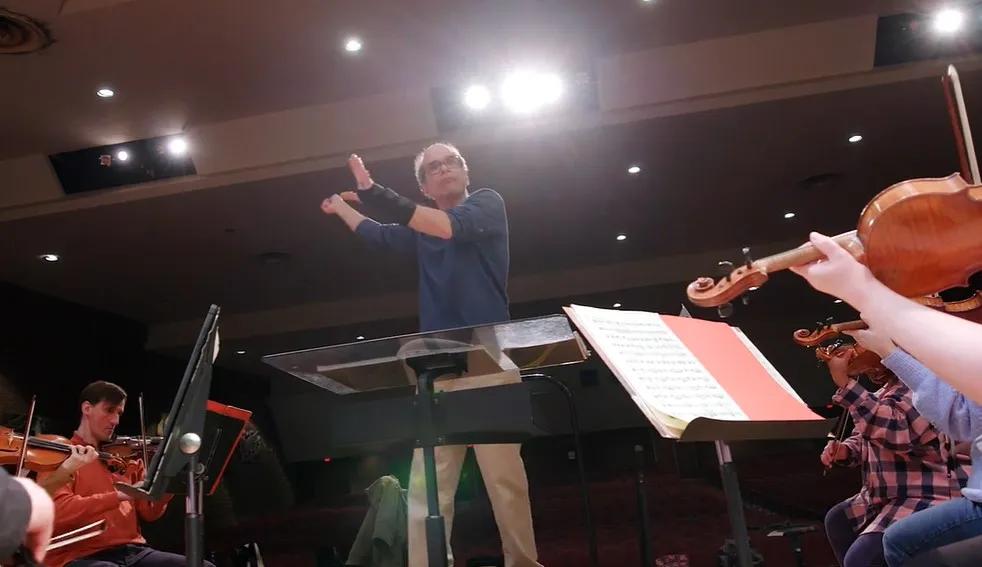
Image content: This image is available to view online.
View image online (https://assets.clevelandclinic.org/transform/9d0a8df7-3429-4e83-97cf-7e77a21e0378/Rand-Laycock)
Music Conductor Rand Laycock
Cleveland Clinic News Service | 216.444.0141
We’re available to shoot custom interviews & b-roll for media outlets upon request.
CCNS health and medical content is consumer-friendly, professional broadcast quality (available in HD), and available to media outlets each day.
CLICK HERE to download soundbites, b-roll, script and web article.
For download password, contact ccnewsservice@ccf.org.
CLEVELAND - As the symphony orchestra plays, Rand Laycock stands front and center, carefully guiding the musicians.
“I'm going to be celebrating 50 years with my community orchestra in three years, and I want to be around for that,” said Rand Laycock.
Rand, who is now 70 years old, was diagnosed with Parkinson’s disease back in 2014.
He was given medication to help manage his symptoms.
They did work at first, but a couple of years ago they seemed to stop.
“I was noticing my symptoms were coming back, and so we upped the dosage. We upped the dose, and it became obvious after a while that I was going to have to do something else,” said Rand.
Rand consulted with Michal Gostkowski, MD, neurologist at Cleveland Clinic.
“With Rand, we had very forward, frank discussions, and for him, it was just improving the tremor, improving the dyskinesias,” said Dr. Gostkowski.
Eventually, the decision was made to do deep brain stimulation.
The surgical procedure involves implanting electrodes into the brain, which are then controlled with a battery-powered device.
“It’s very good for treating tremors, it’s good for reducing medication, it’s good for reducing dyskinesia. But you have to be very clear, it’s not going to fix walking, it’s not going to fix somebody who has blood pressure issues, it’s not going to fix memory,” said Dr. Gostkowski.
Rand had the procedure done last year.
And just a few months ago, he was able to upgrade to new programming.
He now has something called adaptive deep brain stimulation (ADBS).
“The advantage of ADBS is that it's automatically controlled as opposed to me having to kind of guess where the settings have to go. It's like driving a car that's got stick shift versus a car that's got automatic,” said Rand.
Dr. Gostkowski said even though deep brain stimulation has been around for a while, it’s still not widely known.
He encourages those with Parkinson’s disease to speak with their providers about deep brain stimulation and see if it could be an option for them.