Locations:





The study, authored by researchers at Cleveland Clinic and Case Western Reserve University, found patients listed farther from donor-dense regions may face reduced access under revised lung allocation policies
Content is property of Cleveland Clinic and for news media use only.
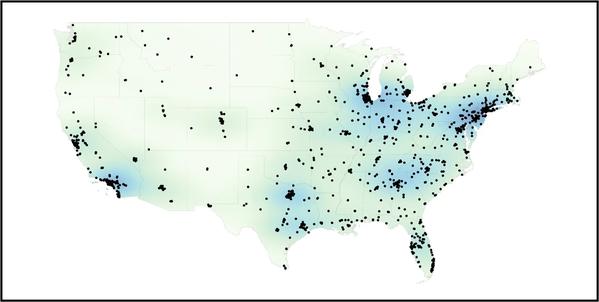
Geographic distribution and density of lung donors in the continental United States: Background shading indicates relative donor density, with lighter areas representing lower donor density and darker areas representing higher donor density. Black points indicate donor hospitals with at least one donor lung recovered for transplant.
A new study from Cleveland Clinic and Case Western Reserve University found that geographic location remains an important factor in access to donor lungs in the United States, even after recent updates to the national lung allocation system changed how donor lungs are distributed.
The study, published in CHEST, evaluated early experience under the lung Composite Allocation Score (CAS), a system designed to prioritize transplant candidates based on factors including medical urgency, projected post-transplant survival and biological compatibility. Researchers also modeled the potential effects of a recent policy amendment that increased the influence of geographic efficiency, giving greater weight to donor-candidate proximity in transplant candidate ranking.
Using national transplant registry data, investigators analyzed 3,917 adult lung transplant candidates at 61 U.S. transplant centers and found substantial regional differences in donor availability, with lower effective donor availability observed in the western United States compared with parts of the Midwest and South.
“Our analysis found that access to donor lungs continues to vary across the country,” said Maryam Valapour, M.D., director of lung transplant outcomes at Cleveland Clinic. “The study also found that placing greater emphasis on how close a patient is to a donor hospital may make it harder for some patients to receive compatible donor lungs. This is important because while lung transplants have been increasing, there is still a shortage of organs, and more people are added to the wait list every day.”
Researchers measured what they described as “distance-adjusted donor availability,” an estimate of the biologically compatible donor pool available to a patient after accounting for donor-candidate distance weighting within the CAS system. The study found that donor availability varied substantially by region, with transplant centers in the West Census region experiencing approximately 30% lower effective donor availability compared with centers in the Midwest.
Researchers then modeled the effects of a newly amended policy that gives greater weight to donor-candidate proximity in transplant candidate ranking. The analysis found that the amended policy would further reduce effective donor availability across all Census regions and widen geographic differences in donor access.
Researchers also performed “match-run” analyses to evaluate how candidate prioritization changed under the amended policy. They found that 23.9% of lung transplant candidates ranked within the top 10 positions under the prior CAS policy fell outside the top 10 under the amended policy, meaning the sickest patients may not be the first to be offered donor lungs depending on their location
The study further found that candidates with biological conditions or features that make donor matching difficult, including patients with blood type O, experienced greater de-prioritization under the amended policy.
“Although the national lung allocation system has evolved in recent years, our findings suggest meaningful regional differences in donor access remain,” said Jarrod Dalton, Ph.D., Director of the Center for Populations Health Research at Cleveland Clinic. “The study also found that changes increasing the importance of geographic proximity may have a greater effect on patients with fewer compatible donor options.”
The study used data from the Scientific Registry of Transplant Recipients (SRTR), which includes information on all donors, waitlisted candidates and transplant recipients in the United States.
Cleveland Clinic is a nonprofit multispecialty academic medical center that integrates clinical and hospital care with research and education. Founded in 1921 by four renowned physicians with a vision of providing outstanding patient care based upon the principles of cooperation, compassion and innovation, Cleveland Clinic has pioneered many medical breakthroughs, including coronary artery bypass surgery and the first face transplant in the United States. Cleveland Clinic is consistently recognized in the U.S. and throughout the world for its expertise and care. Among Cleveland Clinic’s 83,000 employees worldwide are more than 6,600 salaried physicians and researchers, and 21,900 registered nurses and advanced practice providers, representing 140 medical specialties and subspecialties. Cleveland Clinic is a 6,725-bed health system that includes a 173-acre main campus near downtown Cleveland, 23 hospitals, 300 outpatient facilities, including locations in northeast Ohio; Florida; Las Vegas, Nevada; Toronto, Canada; Abu Dhabi, UAE; and London, England. In 2025, there were 15.9 million outpatient encounters, 343,000 hospital admissions and observations, and 336,000 surgeries and procedures throughout Cleveland Clinic’s health system. Visit us at clevelandclinic.org. Follow us at x.com/CleClinicNews. News and resources are available at newsroom.clevelandclinic.org.
Editor’s Note: Cleveland Clinic News Service is available to provide broadcast-quality interviews and B-roll upon request.





 Search