Locations:




 Search
Third annual Cleveland Discovery and Innovation Forum convenes global leaders to examine the future of advanced computing in biomedical research
Content is property of Cleveland Clinic and for news media use only.
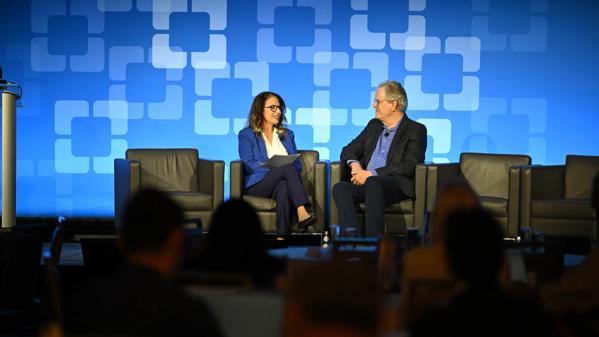
Cleveland Clinic Chief Research Information Officer Lara Jehi, M.D., discusses how advanced computational methods are transforming healthcare through AI, with Curtis Priem of Rensselaer Polytechnic Institute.
The third annual Cleveland Discovery and Innovation Forum, hosted by Cleveland Clinic and IBM, highlighted progress in applying quantum computing and AI to healthcare and life sciences research. The forum brought together global leaders in healthcare, science and technology to share insights into how advanced computing is accelerating discovery and shaping the future of patient care.
The one-day event, held today on Cleveland Clinic’s Main Campus, featured more than 30 speakers from academia, industry, foundations, venture capital and government. Discussions focused on the growing impact of AI and quantum computing in tackling some of the most complex challenges in healthcare and life sciences research.
“The Cleveland Discovery and Innovation Forum highlighted how AI and quantum computing are advancing research across every stage of disease – from prevention and early detection to treatment,” said Lara Jehi, M.D., Cleveland Clinic’s Chief Research Information Officer. “Cleveland Clinic is at the forefront of applying quantum computing to life sciences research. Through this forum and our broader research efforts, we are helping define how advanced computing can unlock new scientific insights and ultimately improve care for patients around the world.”
The forum also highlighted five years of progress by Cleveland Clinic’s and IBM’s Discovery Accelerator, a partnership focused on advancing the pace of biomedical research through high-performance computing, AI and quantum computing. Since its launch, the Discovery Accelerator has supported more than 50 projects, contributed to multiple peer-reviewed publications and developed an innovative education curriculum aimed at building the skilled workforce needed for the future.
“As we mark five years of our collaboration with Cleveland Clinic, we are seeing how quantum and AI can work together to transform biomedical research — modeling molecular interactions, refining machine learning for personalized care, and pushing the boundaries of what's achievable across healthcare and life sciences,” said Alessandro Curioni, Ph.D., IBM Fellow and Vice President, Algorithms and Applications, IBM Research.
The agenda included keynote presentations, panel discussions and fireside chats led by Cleveland Clinic and IBM executives alongside international leaders. Featured speakers included Eric Isaacs, Ph.D., of Research Corporation for Science Advancement; Curtis Priem, Rensselaer Polytechnic Institute and co-founder of NVIDIA; Alex Shalek, Ph.D., MIT; Sergii Strelchuk, University of Oxford; Serpil Erzurum, M.D., Cleveland Clinic; Alessandro Curioni, Ph.D., IBM; and Percy Carter, Pfizer.
Sessions included panels on applied quantum computing and its role in building a world-class research and healthcare ecosystem, and how AI and quantum computing can realize the potential of personalized therapy as well as a fireside chat on visionary leadership and advanced computational methods in healthcare.
The forum also featured a project showcase from Cleveland Clinic and IBM researchers, including recent work modeling a protein of more than 12,000 atoms, the largest protein structure known to be simulated on a quantum computer. The findings underscore the growing potential of quantum computers as scientific tools for solving fundamental problems in biology, chemistry and life sciences.
Several research announcements and updates were shared during the event and highlighted Cleveland Clinic’s steadfast progress in shaping quantum computing applications in medicine, and building the Ohio Discovery Corridor through its Cleveland Innovation District. These included:
Cleveland Clinic is a nonprofit multispecialty academic medical center that integrates clinical and hospital care with research and education. Founded in 1921 by four renowned physicians with a vision of providing outstanding patient care based upon the principles of cooperation, compassion and innovation, Cleveland Clinic has pioneered many medical breakthroughs, including coronary artery bypass surgery and the first face transplant in the United States. Cleveland Clinic is consistently recognized in the U.S. and throughout the world for its expertise and care. Among Cleveland Clinic’s 83,000 employees worldwide are more than 6,600 salaried physicians and researchers, and 21,900 registered nurses and advanced practice providers, representing 140 medical specialties and subspecialties. Cleveland Clinic is a 6,725-bed health system that includes a 173-acre main campus near downtown Cleveland, 23 hospitals, 300 outpatient facilities, including locations in northeast Ohio; Florida; Las Vegas, Nevada; Toronto, Canada; Abu Dhabi, UAE; and London, England. In 2025, there were 15.9 million outpatient encounters, 343,000 hospital admissions and observations, and 336,000 surgeries and procedures throughout Cleveland Clinic’s health system. Visit us at clevelandclinic.org. Follow us at x.com/CleClinicNews. News and resources are available at newsroom.clevelandclinic.org.
Editor’s Note: Cleveland Clinic News Service is available to provide broadcast-quality interviews and B-roll upon request.