Locations:


Patients achieved meaningful two-year weight loss after undergoing bariatric surgery
Content is property of Cleveland Clinic and for news media use only.
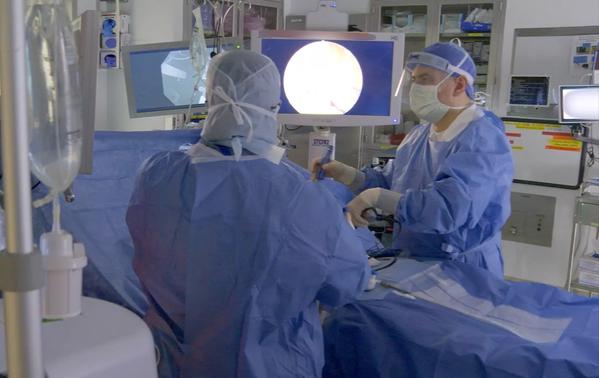
Ali Aminian, M.D., performing bariatric surgery.
A Cleveland Clinic study has found that people with obesity who do not tolerate the weight-loss medications semaglutide or tirzepatide, or who do not lose enough weight with the medications, can achieve substantial weight loss after bariatric surgery. The research was published today in Annals of Surgery.
Bariatric surgery, also known as weight-loss surgery, is a safe and effective treatment for obesity that changes the digestive system to help people lose weight and maintain long-term weight loss.
GLP-1 medications like semaglutide and tirzepatide have become important options for treating obesity by helping regulate appetite and food intake. However, some patients have difficulty tolerating these medications, while others do not achieve the amount of weight loss they need. Previous research has found that roughly half of patients in real-world practice stop taking them within a year, making additional treatment options important.
The study found that bariatric surgery remained highly effective for patients who saw little to no benefit from GLP-1 medications. While patients lost about 2% of their body weight or less within two years of starting the medications, they lost approximately 18% to 33% of their total body weight within two years of bariatric surgery. In several groups, weight loss was comparable to that of patients who had never used GLP-1 medications.
“GLP-1 medications have transformed obesity care, but they don’t work for everyone,” said Ali Aminian, M.D., director of Cleveland Clinic’s Bariatric and Metabolic Institute, and lead author of the study. “A growing number of patients and their doctors are asking: what’s the next step? Our findings show that bariatric surgery can be that next step.”
The observational study included 4,929 adults with obesity who underwent bariatric surgery at Cleveland Clinic hospitals in Ohio between 2018 and 2024. Researchers compared two-year total body weight loss outcomes among three groups: 4,661 patients who had not previously taken semaglutide or tirzepatide, 61 patients who stopped the medications because of intolerable side effects, and 207 patients who experienced inadequate weight loss while taking the medications. At the time of surgery, median body weight across the three groups ranged from approximately 273 to 287 pounds.
After accounting for age, sex, diabetes and other factors, study results showed the following total body weight loss two years after bariatric surgery, with results varying by surgical approach. In each group, the lower figure reflects gastric sleeve and the higher figure reflects gastric bypass:
These findings suggest that patients who lose little weight with semaglutide or tirzepatide may still achieve substantial weight loss with bariatric surgery. As the use of obesity medications grows, surgery can be an effective option for patients who cannot tolerate these medications or do not achieve their weight loss goals. Both surgical approaches had low rates of complications.
According to the researchers, the study has some limitations. It was observational, the medication groups were relatively small, follow-up was limited to two years, and researchers could not confirm how consistently patients took their medications. The findings also do not mean that bariatric surgery is the appropriate next step for every patient who experiences medication intolerance or inadequate weight loss. Treatment decisions should be individualized based on a patient's health, treatment history and preferences.
“Not losing weight with a GLP-1 medication doesn’t mean a patient won’t lose weight after bariatric surgery,” said Dr. Aminian. “These treatments are not competing approaches. They are complementary tools, and bariatric surgery can help patients achieve substantial weight loss when medications alone have not been effective.”
Cleveland Clinic is a nonprofit multispecialty academic medical center that integrates clinical and hospital care with research and education. Founded in 1921 by four renowned physicians with a vision of providing outstanding patient care based upon the principles of cooperation, compassion and innovation, Cleveland Clinic has pioneered many medical breakthroughs, including coronary artery bypass surgery and the first face transplant in the United States. Cleveland Clinic is consistently recognized in the U.S. and throughout the world for its expertise and care. Among Cleveland Clinic’s 83,000 employees worldwide are more than 6,600 salaried physicians and researchers, and 21,900 registered nurses and advanced practice providers, representing 140 medical specialties and subspecialties. Cleveland Clinic is a 6,725-bed health system that includes a 173-acre main campus near downtown Cleveland, 23 hospitals, 300 outpatient facilities, including locations in northeast Ohio; Florida; Las Vegas, Nevada; Toronto, Canada; Abu Dhabi, UAE; and London, England. In 2025, there were 15.9 million outpatient encounters, 343,000 hospital admissions and observations, and 336,000 surgeries and procedures throughout Cleveland Clinic’s health system. Visit us at clevelandclinic.org. Follow us at x.com/CleClinicNews. News and resources are available at newsroom.clevelandclinic.org.
Editor’s Note: Cleveland Clinic News Service is available to provide broadcast-quality interviews and B-roll upon request.




 Search