Locations:





Patients had risk factors but no pre-existing heart disease
Content is property of Cleveland Clinic and for news media use only.


Image content: This image is available to view online.
View image online (https://assets.clevelandclinic.org/transform/03ba027d-3030-40d2-bbed-ded42870dad1/FDC_Product_Shoot-3-of-52_jpg)
Bempedoic acid
Findings from a Cleveland Clinic-led clinical trial showed that the use of bempedoic acid (a cholesterol-lowering drug) in statin-intolerant patients – who have not yet had a cardiovascular event, but do have risk factors, like diabetes – significantly reduced the chance of death from heart disease and other major adverse cardiovascular events such as heart attacks and strokes.
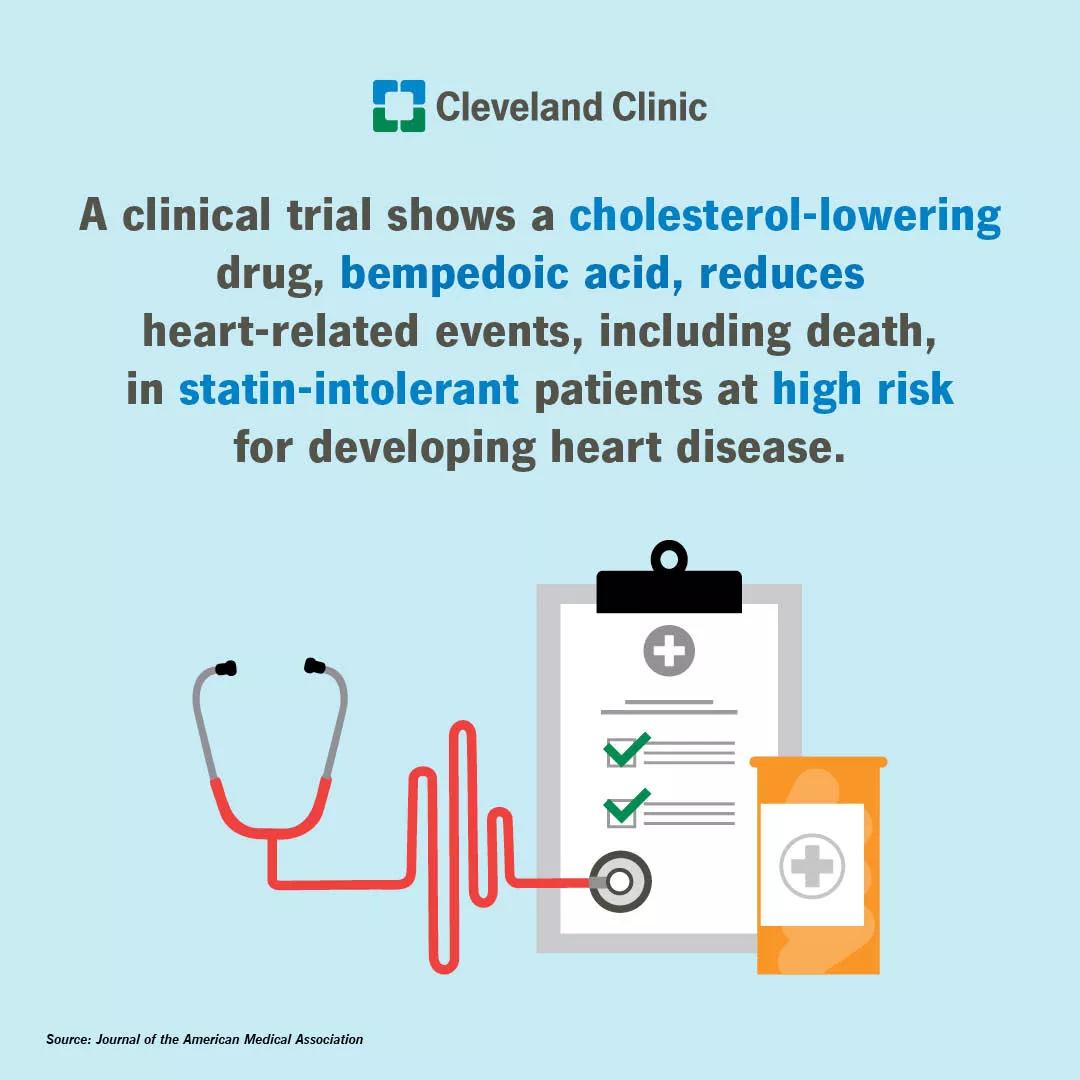
Image content: This image is available to view online.
View image online (https://assets.clevelandclinic.org/transform/7da245c0-39fa-4389-b7ef-a5d351a61a15/23-CCC-4006556-CLEAR-Primary-Prevention-Clinical-Trial-Insta-REV_jpg)
Findings were presented today during a Late Breaking Science Session at the American Diabetes Association’s 83rdAnnual Scientific Session in San Diego and simultaneously published in the Journal of the American Medical Association.
Back in March, results from the CLEAR Outcomes trial showed that bempedoic acid reduced adverse cardiovascular outcomes in 14,000 statin intolerant patients. Within this CLEAR trial, there were 4200 patients enrolled with high risk for heart disease but no previous cardiovascular events (primary prevention). After six months of treatment, bempedoic acid, compared with placebo, reduced LDL cholesterol by 23.2% and reduced inflammation measured by C-reactive protein by 22.7%. In this primary prevention subgroup, there was also a 30% reduction in major cardiovascular events, a 39% reduction in death from heart disease and a 39% decline in heart attacks.
“These findings emphasize the large benefits from lipid-lowering therapy in patients with no prior cardiovascular event, but who are at risk for a first event,” said the study’s lead author Steven E. Nissen, M.D., Chief Academic Officer of the Heart Vascular & Thoracic Institute at Cleveland Clinic. “Approximately two-thirds of the participants had diabetes, which further supports recommendations that primary prevention patients with diabetes should be treated with cholesterol-lowering therapies.”

Image content: This image is available to view online.
View image online (https://assets.clevelandclinic.org/transform/1d0b8db6-c98a-42b1-a699-d37182807610/nissen-steve-074-e1605303442379_jpg)
Steven E. Nissen, M.D.
Primary prevention patients are currently under-treated in the United States, with more than half of patients at high risk for a cardiovascular event not currently receiving cholesterol lowering drugs. Few clinical trials in recent years have studied patients who have not yet had a cardiac event.
Elevated LDL cholesterol can accumulate in the walls of blood vessels, creating blockages and raising the risk of heart attack or stroke. Statins are the standard first-line treatment for the prevention of cardiovascular disease and work by lowering cholesterol levels in the blood. However, some patients struggle with adverse side effects – particularly muscle pain or weakness – that prevent them from using statins at recommended doses. Bempedoic acid differs from statins by not activating until it reaches the liver which limits the drug’s potential to cause adverse muscle effects on muscle.
Adverse effects observed with bempedoic acid included a higher incidence of gout and gallstones.
The study was funded by Esperion Therapeutics, developer of bempedoic acid.
Dr. Nissen has served as a consultant for many pharmaceutical companies and has overseen clinical trials for AbbVie, Amgen, AstraZeneca, Bristol Myers Squibb, Eli Lilly, Novartis, Mineralys, Silence Therapeutics, and Pfizer. However, he does not accept honoraria, consulting fees or other compensation from commercial entities.
Cleveland Clinic is a nonprofit multispecialty academic medical center that integrates clinical and hospital care with research and education. Founded in 1921 by four renowned physicians with a vision of providing outstanding patient care based upon the principles of cooperation, compassion and innovation, Cleveland Clinic has pioneered many medical breakthroughs, including coronary artery bypass surgery and the first face transplant in the United States. Cleveland Clinic is consistently recognized in the U.S. and throughout the world for its expertise and care. Among Cleveland Clinic’s 83,000 employees worldwide are more than 6,600 salaried physicians and researchers, and 21,900 registered nurses and advanced practice providers, representing 140 medical specialties and subspecialties. Cleveland Clinic is a 6,725-bed health system that includes a 173-acre main campus near downtown Cleveland, 23 hospitals, 300 outpatient facilities, including locations in northeast Ohio; Florida; Las Vegas, Nevada; Toronto, Canada; Abu Dhabi, UAE; and London, England. In 2025, there were 15.9 million outpatient encounters, 343,000 hospital admissions and observations, and 336,000 surgeries and procedures throughout Cleveland Clinic’s health system. Visit us at clevelandclinic.org. Follow us at x.com/CleClinicNews. News and resources are available at newsroom.clevelandclinic.org.
Editor’s Note: Cleveland Clinic News Service is available to provide broadcast-quality interviews and B-roll upon request.







 Search