Locations:





 Search
National MENtion It® campaign explores the impact stress has on men’s sexual and mental well-being
A new national survey by Cleveland Clinic highlights a disconnect between men’s perception of their health and their actual health habits.
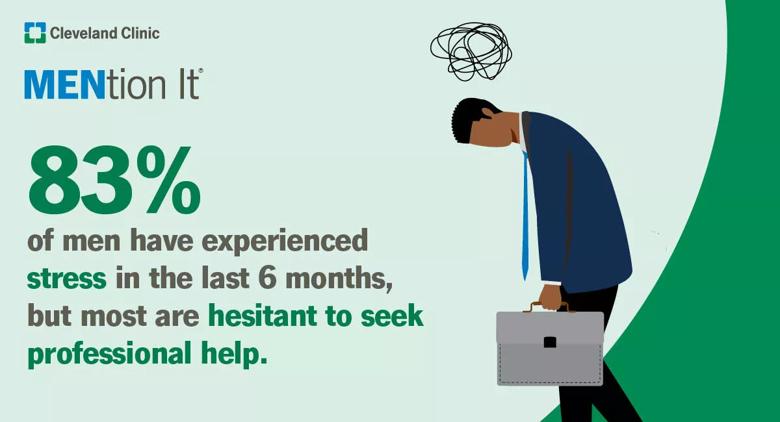
Image content: This image is available to view online.
View image online (https://assets.clevelandclinic.org/transform/4abb06f2-b1d7-4a8d-b221-4a1fddb7ab36/23-CCC-4150815-MENtion-It-2023-infographics-stress_jpg)
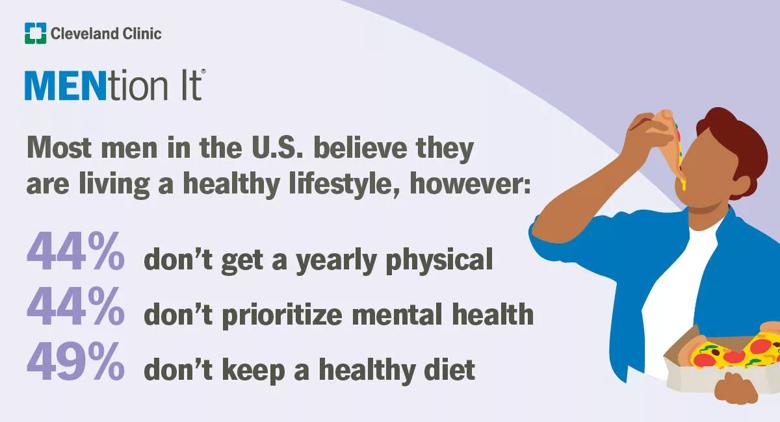
Image content: This image is available to view online.
View image online (https://assets.clevelandclinic.org/transform/0864f921-82c4-41fd-8fb7-49ba9eacb616/23-CCC-4150815-MENtion-It-2023-infographics-lifestyle_jpg)
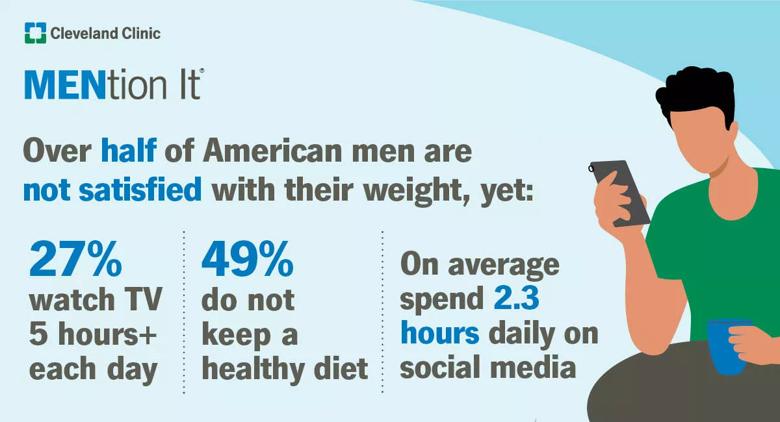
Image content: This image is available to view online.
View image online (https://assets.clevelandclinic.org/transform/795dde00-c0af-4099-a39a-eba898c978ee/23-CCC-4150815-MENtion-It-2023-infographics-weight_jpg)
In the survey, 81% of American men said they believe they are leading a healthy lifestyle. However, the survey results show the habits and behaviors of many men tell a different story.
The survey, which was taken earlier this year by a national sample consisting of 1,000 U.S. males, 18 years of age and older, was issued as part of Cleveland Clinic’s eighth annual educational campaign, MENtion It®. The campaign aims to address the fact that men often do not mention health issues or take steps to prevent them.
Survey findings point to stress being a common factor among men. However, 65% of men said they are hesitant to seek professional help for mental health concerns such as stress, anxiety and depression.
Social media habits may contribute to this with men saying they spend 2.3 hours per day on average scrolling through social media. Those who say they are hesitant to seek professional help for mental health issues are almost twice as likely to spend five or more hours daily on social media (19%).
The survey also indicates that a significant portion of American men (37%) have experienced issues related to sexual health. Despite experiencing issues, only two in five men who experienced sexual problems say they sought professional help.
“We know that there is a direct relationship between a man’s physical, mental and sexual health,” said Georges-Pascal Haber, M.D., Ph.D., chair of the Department of Urology at Cleveland Clinic. “A man’s lifestyle and habits, whether positive or negative, can significantly impact his overall health.
“The first signs of many serious health conditions are often urinary or sexual issues which many men are hesitant to address,” said Haber. “Through the MENtion It campaign, we want to emphasize the significance of being proactive with your health by getting regular screenings, vaccinations and exams to prevent health issues or identify them in curable stages.”
Additional findings:
Methodology
Findings from an online survey conducted among a national sample consisting of 1,000 American males, 18 years of age and older, living in the continental United States completed between June 1st and June 13th in partnership with Savanta.
The total male sample surveyed was nationally representative based on age, gender, ethnicity, region, urban vs. rural, household income, and educational attainment census data. The margin of error for the total sample at the 95% confidence level is +/- 3.1 percentage points.
Cleveland Clinic is a nonprofit multispecialty academic medical center that integrates clinical and hospital care with research and education. Founded in 1921 by four renowned physicians with a vision of providing outstanding patient care based upon the principles of cooperation, compassion and innovation, Cleveland Clinic has pioneered many medical breakthroughs, including coronary artery bypass surgery and the first face transplant in the United States. Cleveland Clinic is consistently recognized in the U.S. and throughout the world for its expertise and care. Among Cleveland Clinic’s 83,000 employees worldwide are more than 6,600 salaried physicians and researchers, and 21,900 registered nurses and advanced practice providers, representing 140 medical specialties and subspecialties. Cleveland Clinic is a 6,725-bed health system that includes a 173-acre main campus near downtown Cleveland, 23 hospitals, 300 outpatient facilities, including locations in northeast Ohio; Florida; Las Vegas, Nevada; Toronto, Canada; Abu Dhabi, UAE; and London, England. In 2025, there were 15.9 million outpatient encounters, 343,000 hospital admissions and observations, and 336,000 surgeries and procedures throughout Cleveland Clinic’s health system. Visit us at clevelandclinic.org. Follow us at x.com/CleClinicNews. News and resources are available at newsroom.clevelandclinic.org.
Editor’s Note: Cleveland Clinic News Service is available to provide broadcast-quality interviews and B-roll upon request.